ARIN 58 Day 1 Recap
Bienvenidos from the Magic City! The ARIN 58 Public Policy and Members Meeting kicked off today at the InterContinental Miami, right on the shores of Biscayne Bay. We’re delighted to welcome new and returning community members joining us in person and online for policy discussions, organizational updates, and plenty of networking and conversation. Read on for a roundup of what has happened so far, and take a look at the full ARIN 58 agenda for what’s still to come.
Want to join the discussions remotely? Register before tomorrow so we can invite you to the Zoom webinar.
Making Waves Before Day One
This fall, the ARIN Fellowship Program once again gave Fellows the opportunity to take part in the NANOG conference directly preceding the ARIN meeting. At NANOG 98, Fellows prepared to participate actively at ARIN 58 by networking with colleagues, building friendships, and learning from the discussions and presentations held earlier in the week.
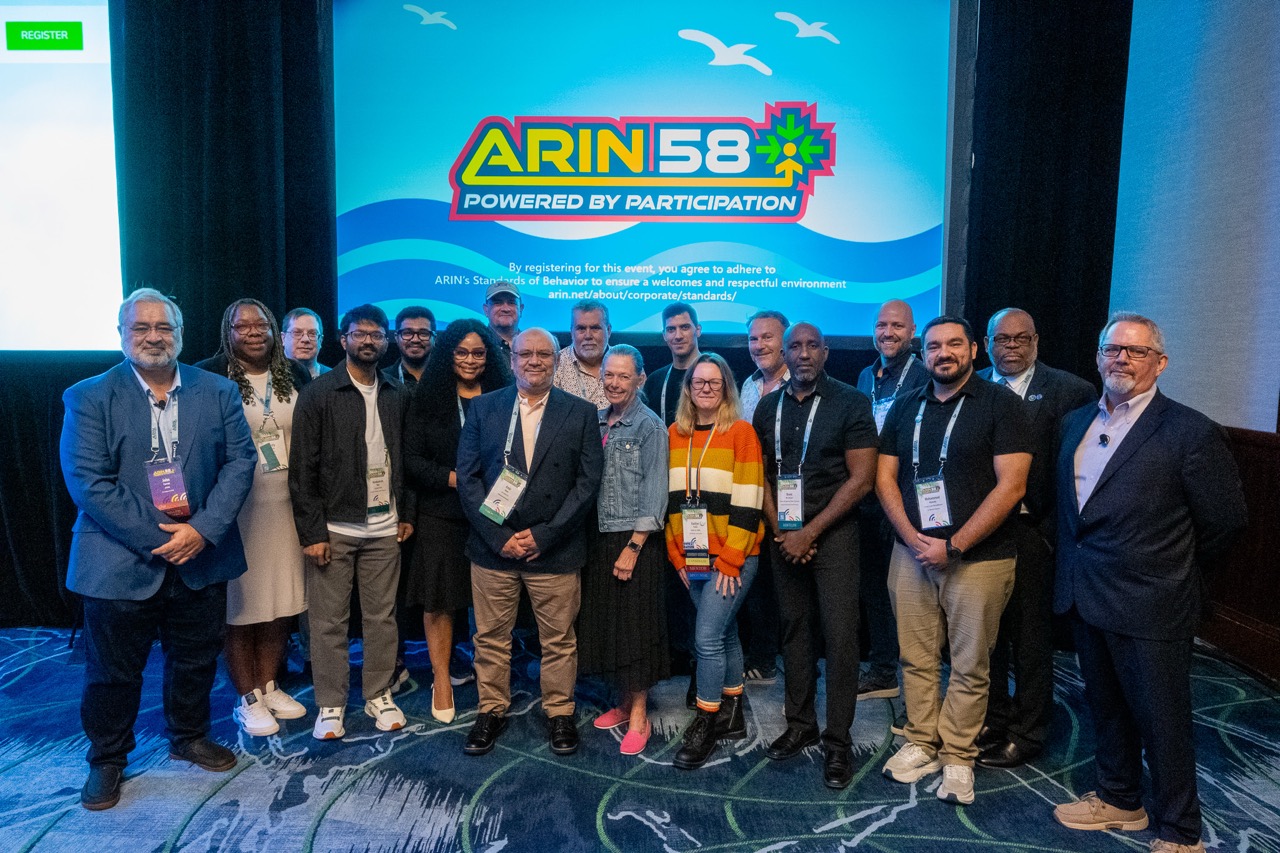
On Wednesday evening, the wider group of in-person attendees joined in at the Welcome Reception on the hotel’s lower pool deck, a great chance to catch up with friends old and new before the meeting’s busy agenda kicked off this morning.

Setting Sail
Hollis Kara, Director of Communications, started the day with opening announcements, introductions of our Board of Trustees, Advisory Council (AC), and Number Resource Organization Number Council (NRO NC), and an overview of the meeting agenda. She also thanked our ARIN 58 platinum sponsor, Amazon Web Services; network sponsor, AT&T; silver co-sponsors, Secure64 and Flashstart; exhibitor sponsor, IPv4.Global by Hilco Global; and espresso bar sponsor, Verisign, and shared tips to help both virtual and in-person attendees make the most of the meeting.
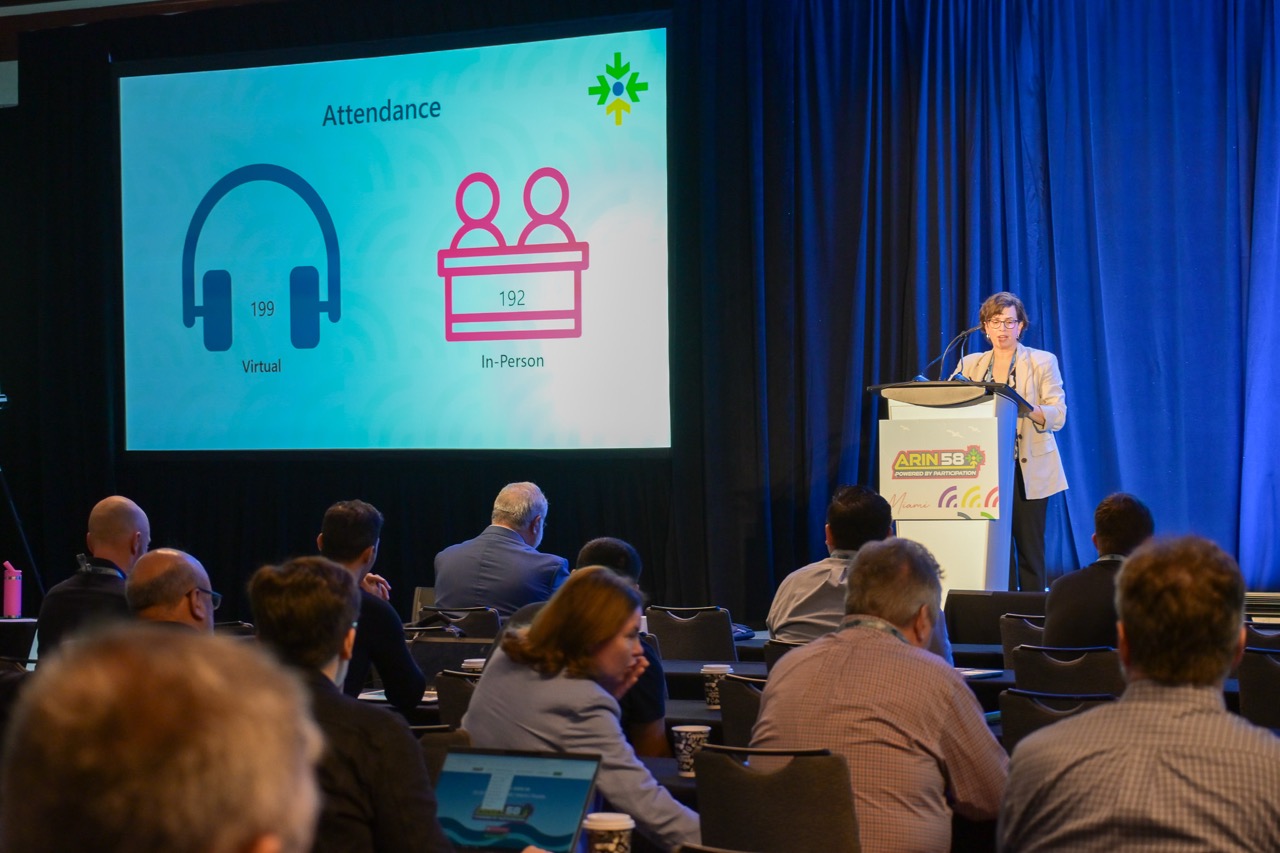
Hollis reviewed ARIN’s Standards of Behavior and welcomed back Wade Hinton of Hinton & Company, who serves as the meeting ombudsperson to help make ARIN 58 a safe and inclusive space for all participants.
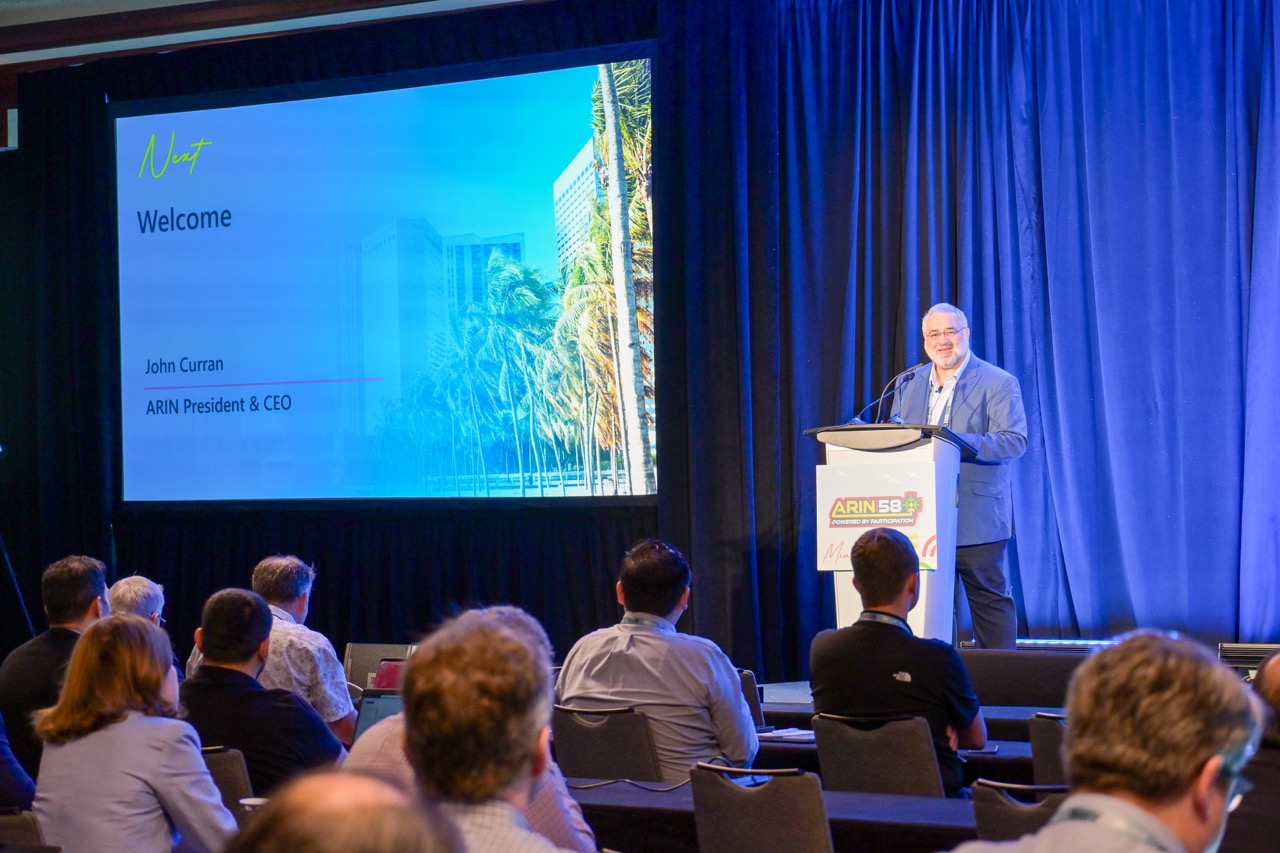
Before the morning’s presentations and updates, we heard opening remarks from John Curran, ARIN President and CEO, who highlighted the importance of these meetings as a forum for developing number resource policy and encouraged attendees to engage in discussion while connecting with one another to keep the community strong. He also noted that while the job of allocating IP addresses is relatively simple, it has to be done the way the community wants it to be with the policies they set, and he encouraged attendees to talk to one another to hear each other’s concerns and issues.
Charting the Course
Nancy Carter, Chair of the ARIN Board of Trustees, delivered the Board of Trustees Report. After a brief history lesson about our host city, including on its name (from the Mayaimi tribe) and nickname (Magic City, because it seemed to grow like magic), Nancy reviewed the Board’s oversight actions since the last meeting, including approval of a 5 percent increase in registry service fees for 2027, a strategic investment in ARIN’s registry infrastructure, funding for recommended grants, and the formation of an IPv6 Task Force. Nancy also shared that the Board endorsed and refined the ARIN Strategic Plan for 2026-2028, which is organized around four strategic priorities: Global Leadership; Governance and Organizational Resilience; Member Experience and Advocacy; and Operational and Technical Excellence. She closed with updates from each of the Board’s committees: Finance, Nomination, Risk and Cybersecurity, Governance, and Compensation.
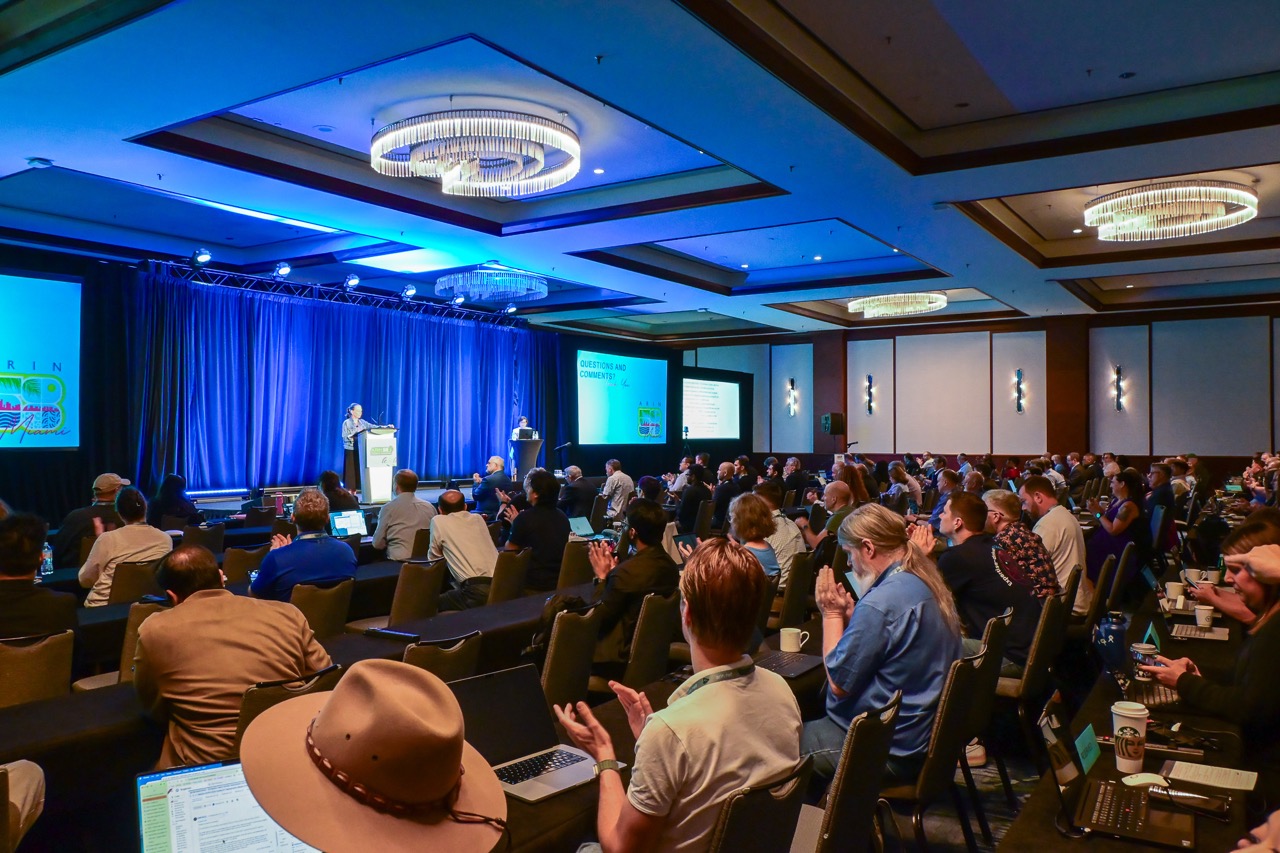
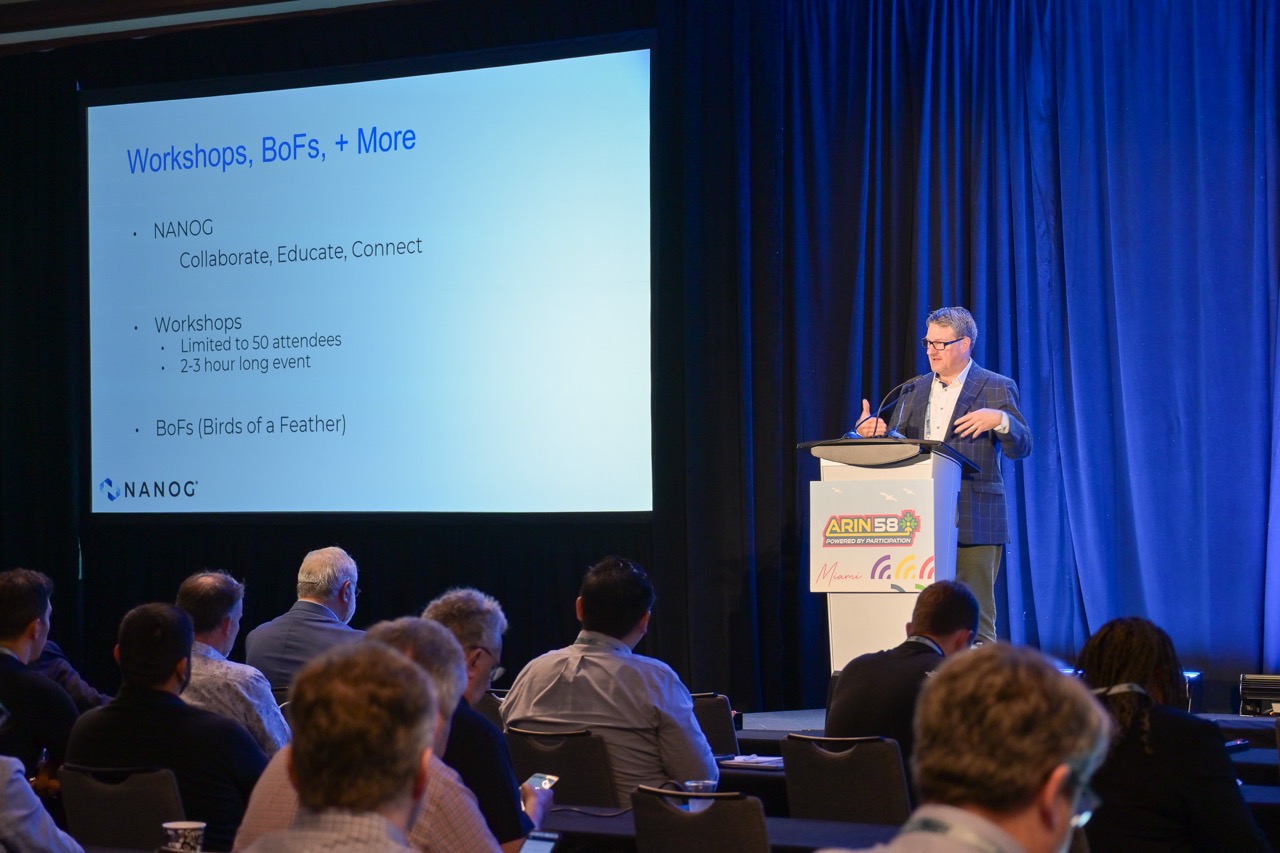
NANOG Executive Director Jonathan Black then provided an update on NANOG, covering its governance, content, and community. Highlights included NANOG’s fully searchable website, now out of beta, its presentations archive, and its workshops and Birds of a Feather sessions. He also shared upcoming events: NANOG 99 in Boston (22-24 February 2027), NANOG 100 in San Francisco (28-30 June 2027), and NANOG 101 in New Orleans (18-20 October 2027), which will be held back to back with ARIN 60.
Policy Implementation and Experience
Up next, Chief Experience Officer John Sweeting gave the Policy Implementation and Experience Report, which examined three topics:
- 4.1.8 ARIN Waitlist: Fulfillment with Multiple Blocks. Current policy requires IPv4 Waiting List requests to be filled with a single contiguous block, so ARIN cannot combine several smaller noncontiguous blocks to fill one request. John posed the questions to the community: Is this multiblock restriction still necessary? Is it still necessary for aggregation to affect fulfillment of IPv4 blocks to the Waiting List? Is it still necessary to issue blocks greater than /24 in size, even though it results in serving fewer organizations with available space?
- NRPM 8.3 and 8.4: Recipient 12-Month Wait to Source. Some transfer recipients have been unaware that they must wait 12 months before transferring IPv4 space back out, because the requirement isn’t stated in the recipient sections of the policy. The questions posed to the community were: Should the Recipient sections of NRPM 8.3 and 8.4 include language to inform Recipients of the 12-month restriction to Source organizations? Should ARIN initiate NRPM 12 Resource Review for recipients who seek to initiate a source transfer within 12 months?
- Implementation of ARIN-2025-2: Clarify 8.5.1 Registration Services Agreement. Implemented 3 March 2026, this change gave staff flexibility to determine which Registration Services Agreement (RSA) versions are current. In the first six months, 72 of the 490 organizations completing 8.3 or 8.4 transfers (14.7 percent) were spared from signing a new RSA, significantly reducing transfer processing time.
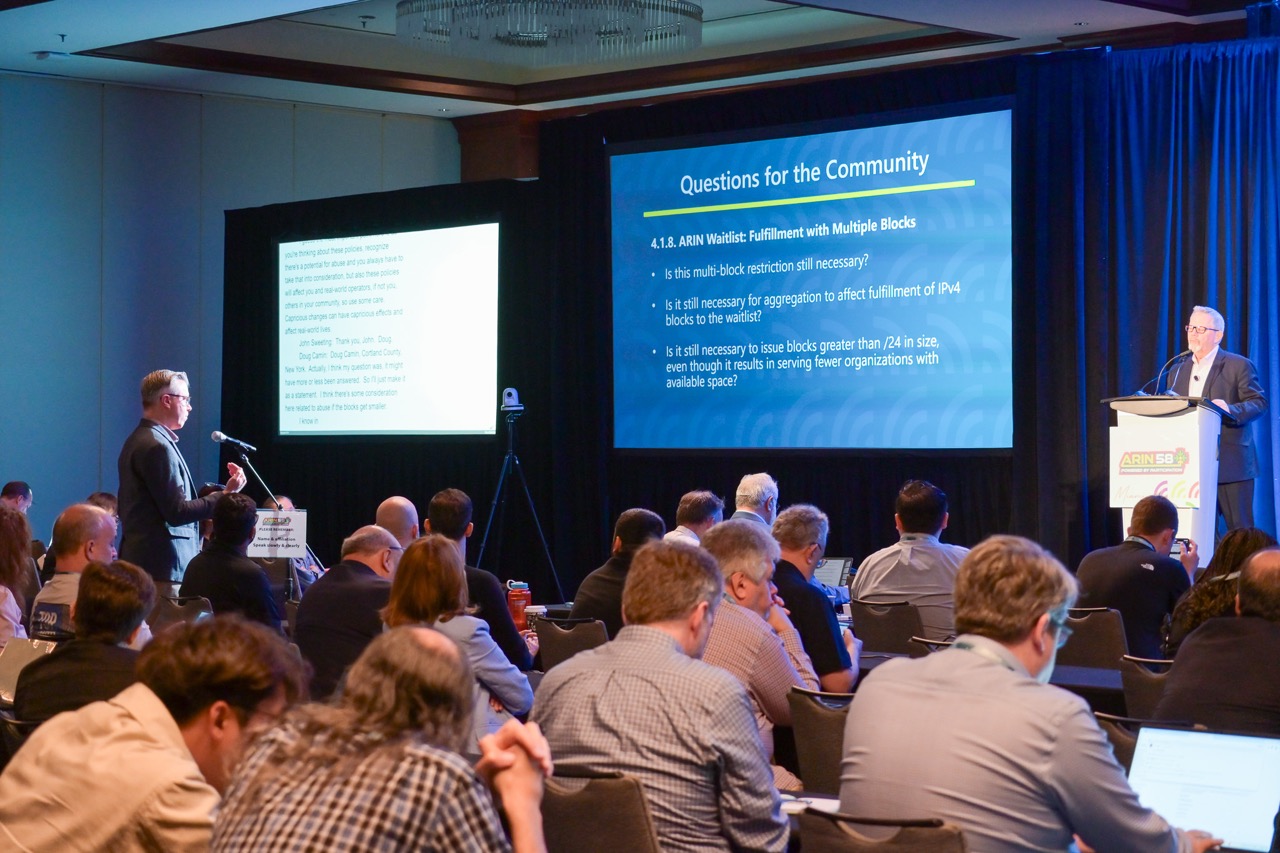
During Q&A, community members weighed in on the IPv4 Waiting List, with participants making points about Waiting List abuse and customers receiving /24s vs. /22s. Others shared perspectives on whether the 12-month waiting period before transferring IPv4 space should be done away with altogether.
Join the discussion at the meeting or on our Public Policy Mailing List (PPML).
Policy Discussion, Round One
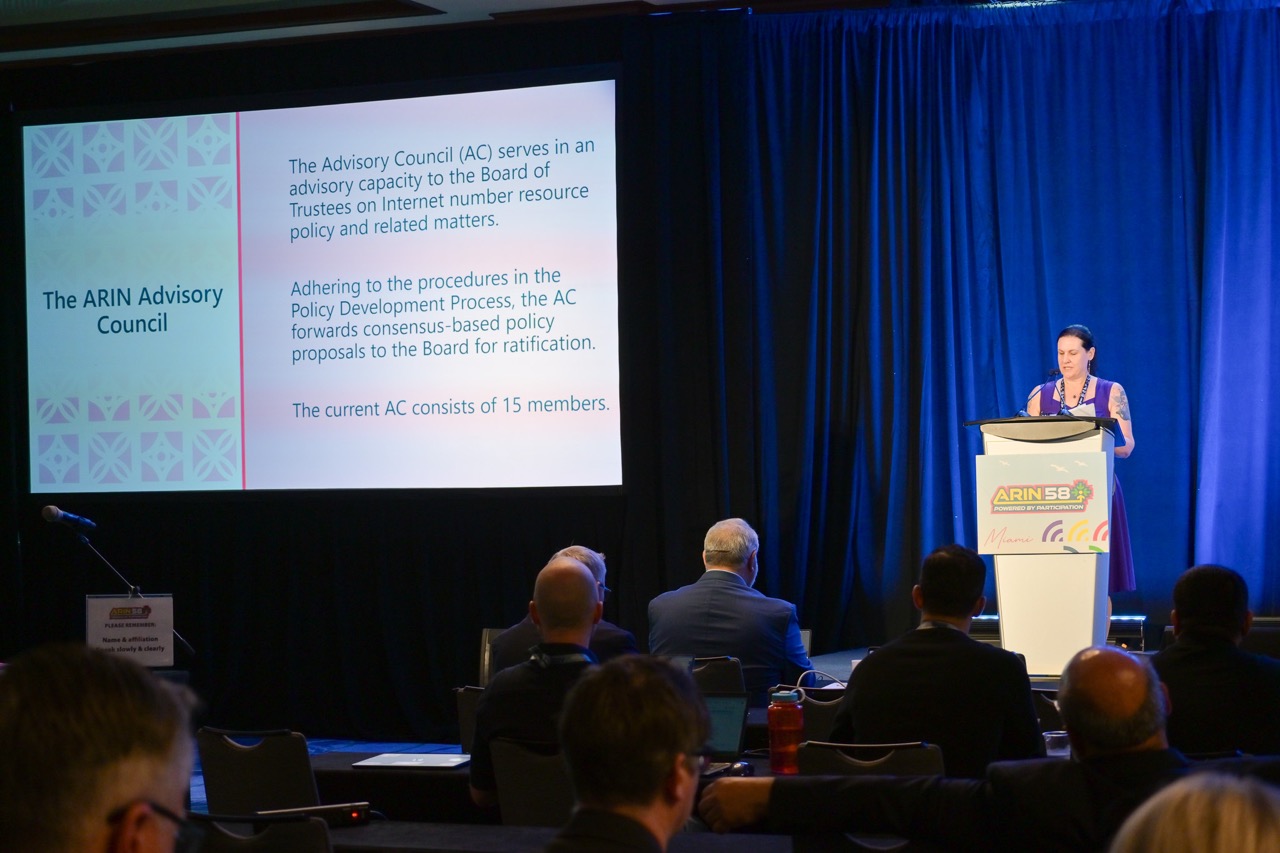
After a short break, Kat Hunter, ARIN Advisory Council (AC) Chair, delivered the Advisory Council Report and On-Docket Report. She introduced the 15-member AC and its role in the Policy Development Process, noted the five AC seats up for election this year and highlighted the work of the AC’s three working groups. She summarized the four proposals received since ARIN 57 along with the nine policies on the ARIN 58 docket.
With that, the first policy block began. AC members presented three Recommended Draft Policies and then opened the floor to community input:
- Recommended Draft Policy ARIN-2025-1: Clarify ISP and LIR Definitions and References to Address Ambiguity in NRPM Text, presented by Leif Sawyer, GCI Communication Corp (ARIN Advisory Council). Adds an explicit definition of Internet Service Provider (ISP) and replaces “ISP” with “Local Internet Registry (LIR)” throughout the Number Resource Policy Manual (NRPM) where appropriate.
- Recommended Draft Policy ARIN-2025-3: Change Section 9 Out Of Region Use Minimum Criteria, presented by Gerry George, DigiSolv, Inc. (ARIN Advisory Council). Lowers the IPv4 space an organization must use within the ARIN region before justifying out-of-region use from a /22 to a /24, while barring out-of-region justification for space from the Waiting List, the Micro-allocation Pool, and the 4.10 block.
- Recommended Draft Policy ARIN-2025-7: Make Policy in 6.5.8.2 Match the Examples, presented by Lily Botsyoe (ARIN Advisory Council). Fixes a math loophole so that a single-site organization clearly receives a /48 IPv6 allocation, and updates “assignment” to “allocation” throughout the section.
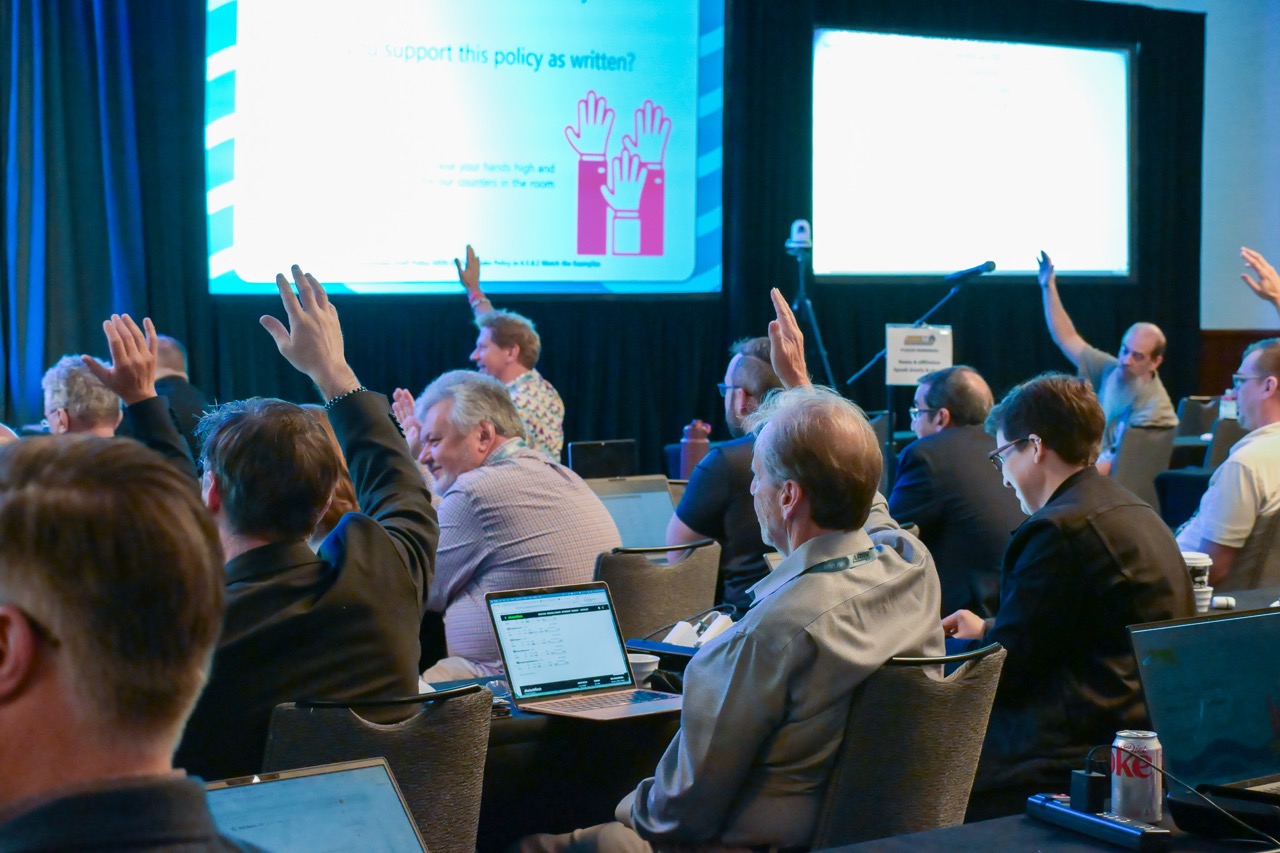
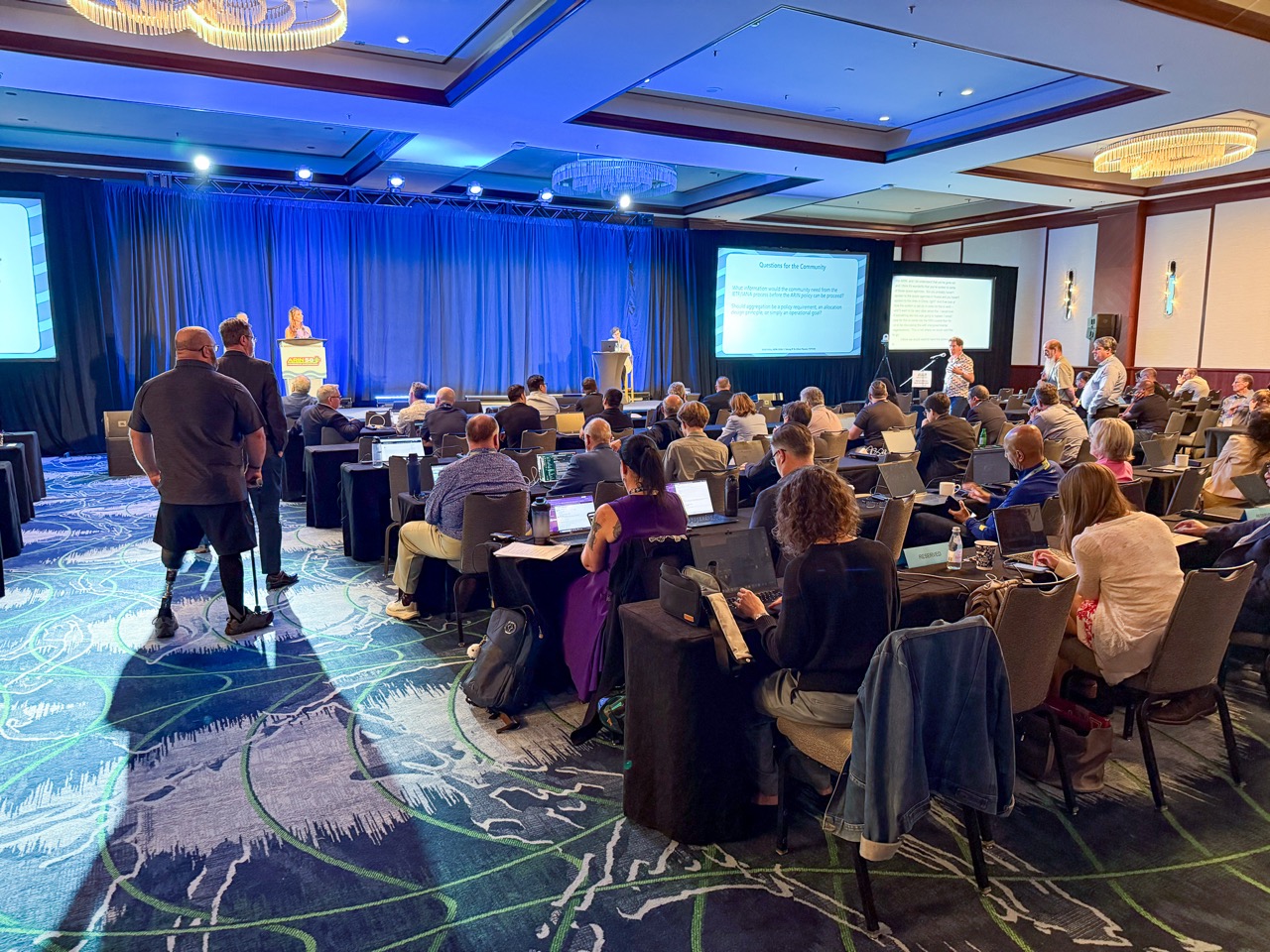
Discussion across the first policy block centered on the differences between an Internet service provider and a Local Internet Registry and who is most affected by changes to the out-of-region use policy for IPv4 resources, with in-person and virtual participants sharing a range of perspectives on how these Recommended Draft Policies should move forward. Show-of-hands polls indicated support for proceeding with the three Recommended Draft Policies, giving the AC valuable input as these policies move through the Policy Development Process.
Want to review previous versions of ARIN policies? Visit the Number Resource Policy Manual to access the Git Repository and the Change Log.
Lunch by the Bay
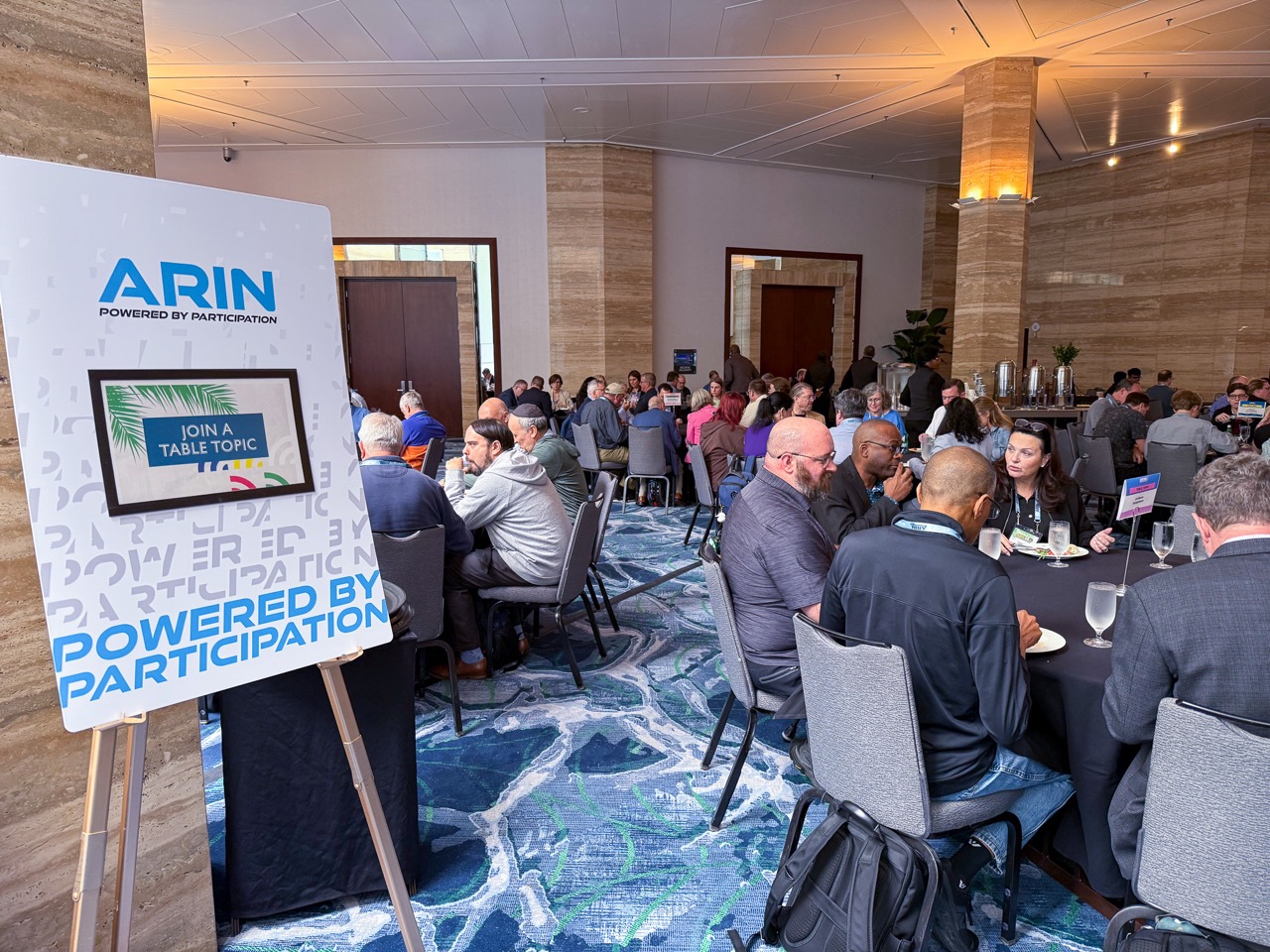
We broke for lunch, where in-person attendees could join optional table topic discussions hosted by AC members on improving the policy engagement experience, Taking IP To Other Planets (TIPTOP), Section 6 IPv6 allocations, Caribbean engagement, and what might take the place of the IPv4 Waiting List if it didn’t exist.
Policy Discussion, Round Two
The afternoon opened with the second policy block, as AC members presented one Recommended Draft Policy and five Draft Policies and invited input from both the room and the virtual audience:
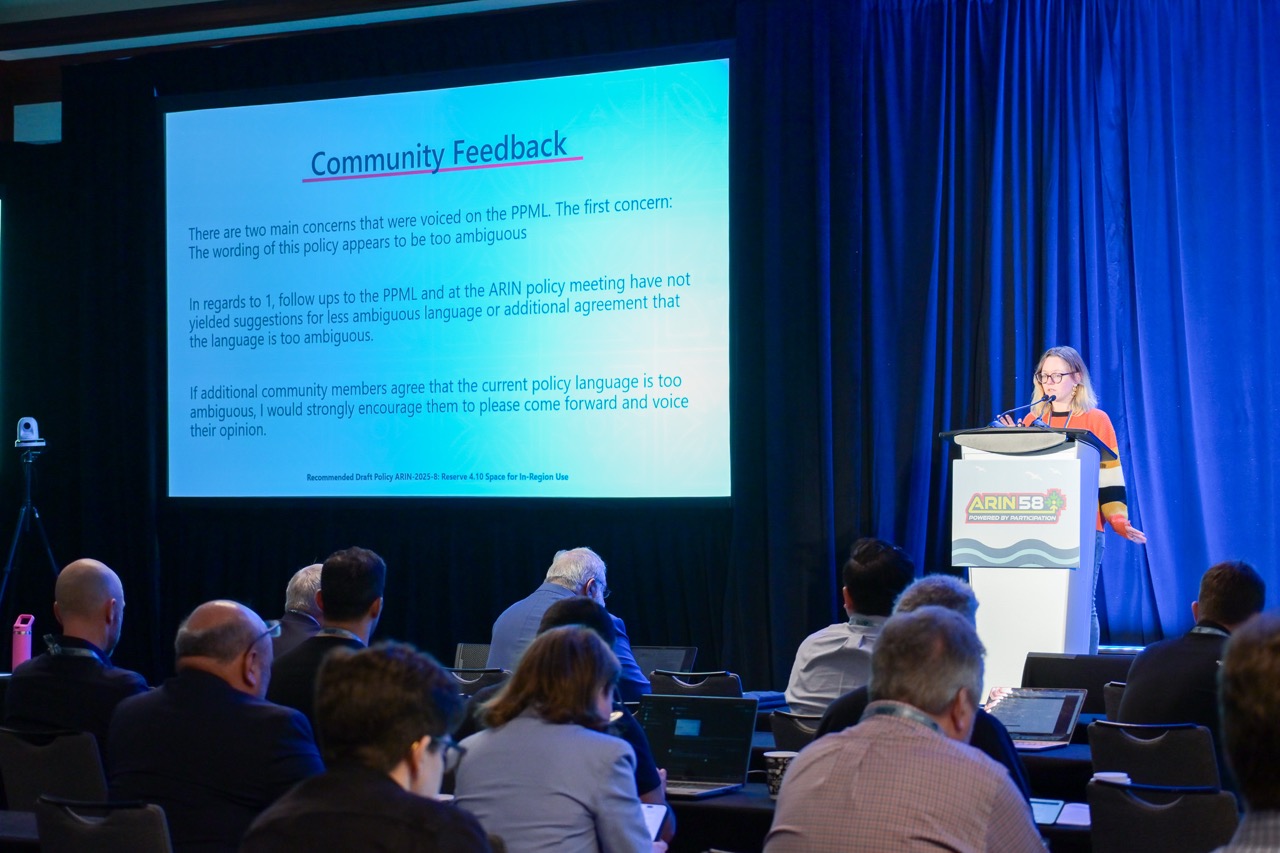
- Recommended Draft Policy ARIN-2025-8: Reserve 4.10 Space for In-Region Use, presented by Kaitlyn Pellak, Amazon (ARIN Advisory Council). Codifies ARIN’s current practice that IPv4 space set aside to facilitate IPv6 deployment may only be used within the ARIN service region.
- Draft Policy ARIN-2026-1: Taking IP To Other Planets (TIPTOP), presented by Alison Wood, State of Oregon (ARIN Advisory Council). Would allow ARIN to allocate address space to networks operating beyond Earth orbit, organized by celestial region to support routing aggregation, as related work continues to develop at the IETF.
- Draft Policy ARIN-2026-2: NRPM Section 6.5 Revision, presented by Matthew Wilder, TELUS (ARIN Advisory Council). Replaces formula-based IPv6 allocation criteria with a planning-based model in which organizations justify requests with a documented network plan.
- Draft Policy ARIN-2026-3: NRPM Section 6.4.1 Retirement, presented by E. Marie Brierley, Saatvik Advisors (ARIN Advisory Council). Retires the NRPM section stating that IPv6 address space is not to be considered property, since those terms belong in the Registration Services Agreement.
- Draft Policy ARIN-2026-4: Harmonize Section 1 and Section 6, Principles and Goals Statements, presented by Brian Jones, Virginia Tech (ARIN Advisory Council). Consolidates overlapping principles and goals language in Sections 1 and 6 of the NRPM to remove duplication without changing their meaning.
- Draft Policy ARIN-2026-5: Define Out Of Region Use, presented by Gus Reese, Cogent Communications (ARIN Advisory Council). Adds a definition clarifying that out-of-region use means using ARIN resources only outside the ARIN region, not simultaneous use inside and outside it, such as anycast.
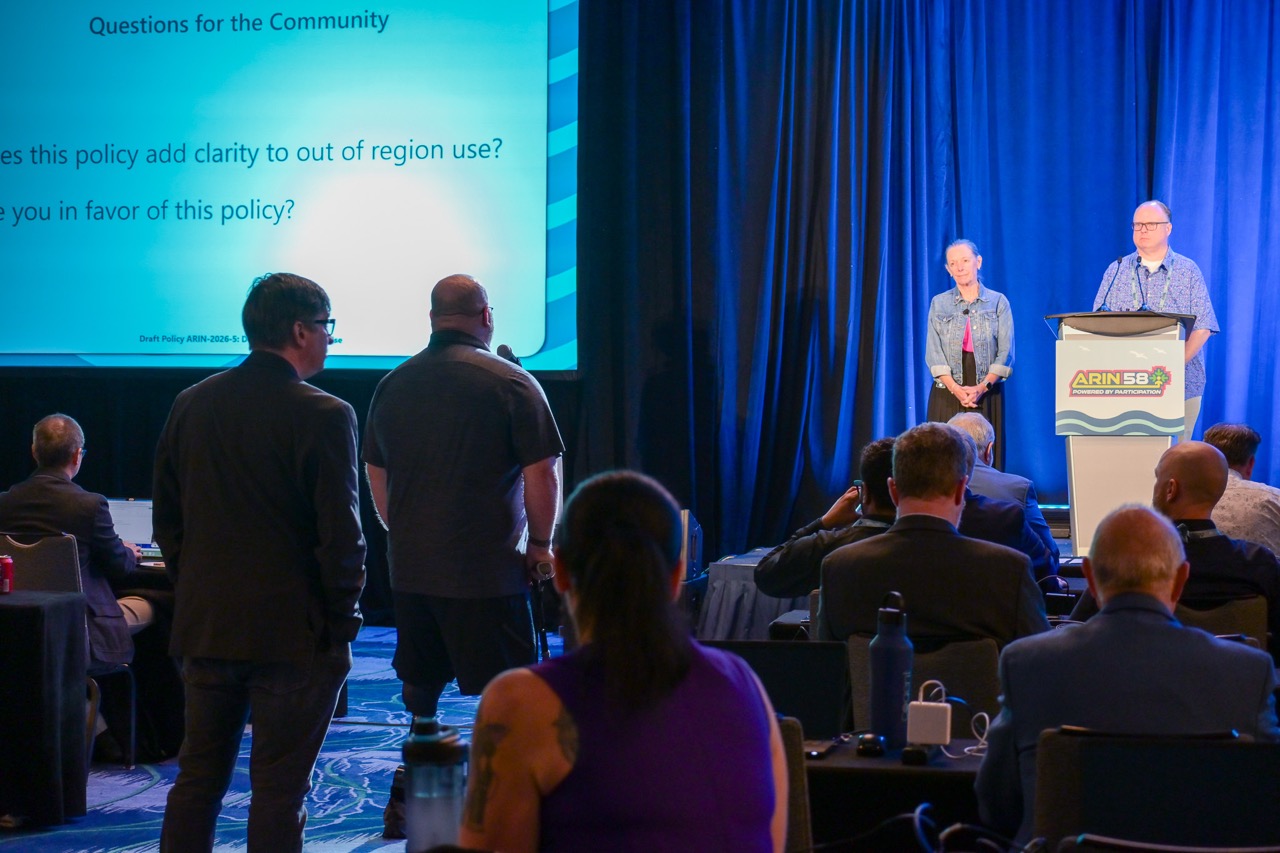
Discussion across the second policy block focused on number resource allocation beyond Earth’s orbit and the nature of celestial bodies, with participants engaging in lively debate over whether TIPTOP is currently out of the NRPM’s scope. The show-of-hands poll for Recommended Draft Policy ARIN-2025-8 indicated support for moving forward with the draft policy.
The engagement throughout both policy blocks showed the strength of ARIN’s bottom-up, community-driven Policy Development Process.
Policy development doesn’t stop when the meeting ends. Keep the conversation going on the Public Policy Mailing List (PPML).
ARIN Elections
Next, Ron da Silva, Network Technologies Global (ARIN Board of Trustees), introduced the 2026 ARIN Elections in his role as Election Officer. He walked through how to get to know the candidates, who is eligible to vote, and how to cast a ballot for up to three Board of Trustees candidates and up to five AC candidates. Ron also shared membership numbers: 2,356 of ARIN’s 2,407 General Members are eligible to vote this year, and 675 General Members who have not voted in two years will be reclassified as Service Members if they don’t cast a vote this year. Attendees then watched candidate introduction videos. Ron also congratulated Kat Hunter, the Board’s 2026 appointee to the NRO NC.
Voting is now open and closes at 7:00 PM ET on Friday, 30 October. Visit arin-elections.net to read candidate bios, view Statements of Support, and watch speeches, then cast your organization’s vote!
Global Governance Updates
Kevin Blumberg, The Wire Inc. (NRO NC), delivered the ASO AC/NRO NC Report. He explained the role of the Address Supporting Organization Address Council, which advises the ICANN Board on Internet number resource policy, and reviewed its 2026 focus on the review of Internet Coordination Policy-2 (ICP-2). Kevin outlined key changes in the Recommended Draft of the RIR Governance Document published 1 September 2026, including a restructured recognition process with a two-thirds RIR support threshold, a five-year regular audit cycle, updated emergency continuity provisions, and a derecognition process that emphasizes rehabilitation as the preferred path.
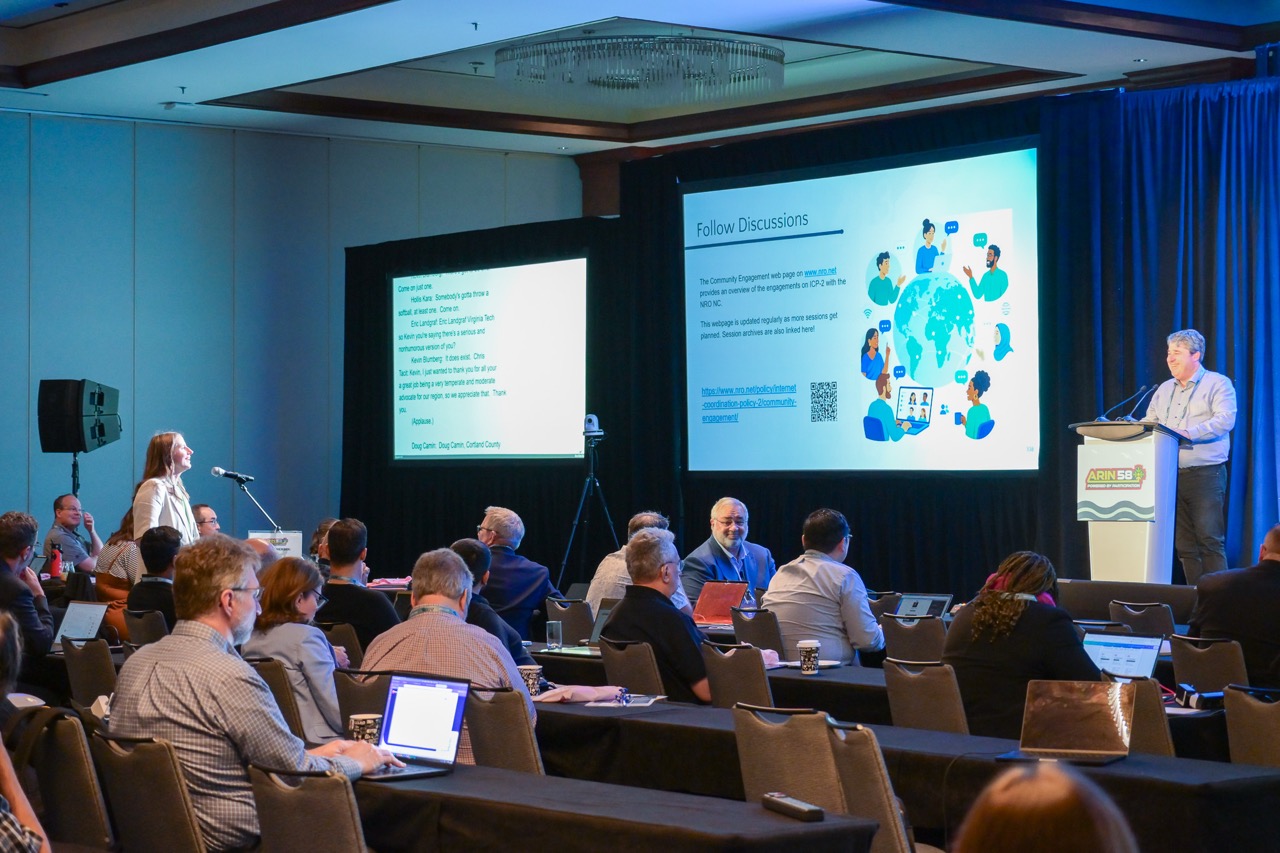
Follow the ICP-2 discussions on the NRO Community Engagement page and join the ARIN ICP-2 Review mailing list to share your input.
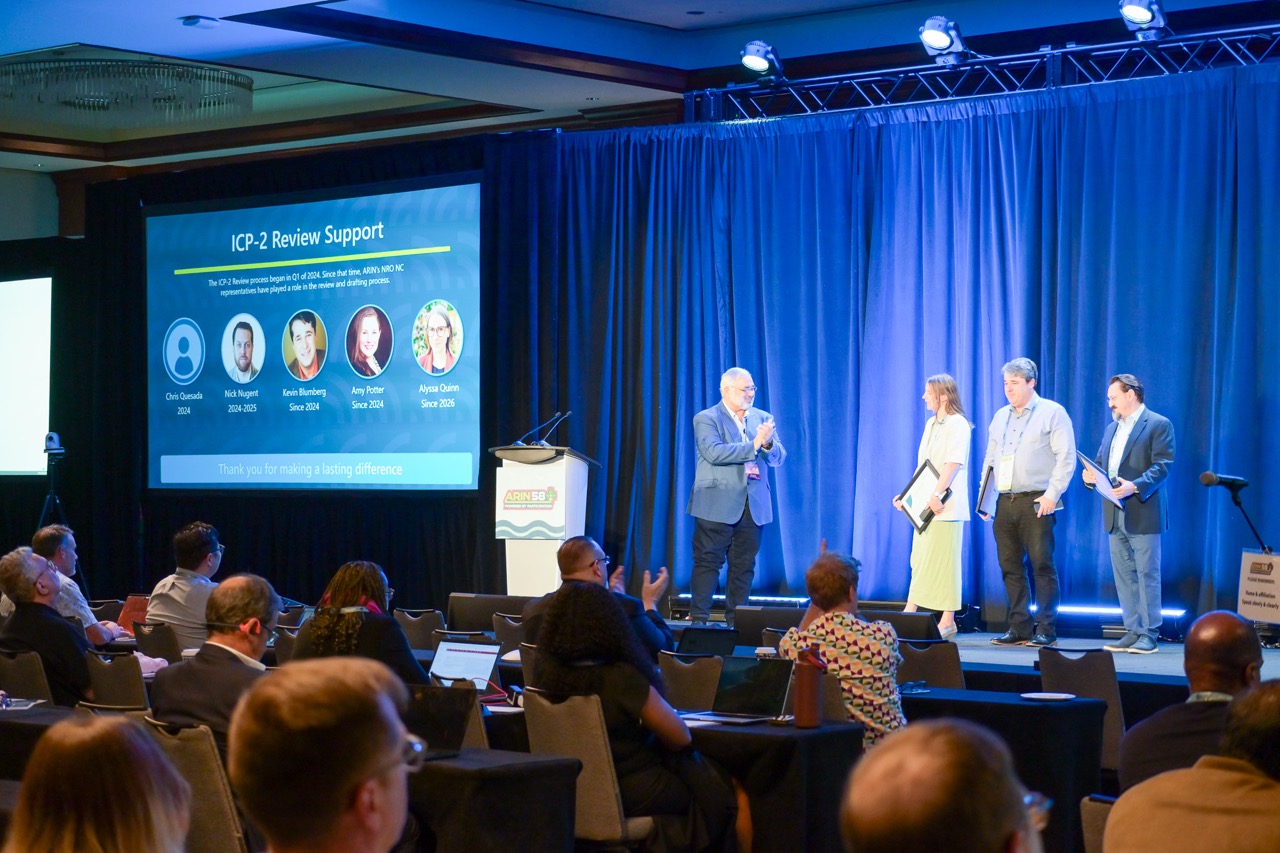
Michael Abejuela, ARIN Chief Legal Officer, followed with an RIR Governance Document Update on where the process stands. He shared that the NRO Executive Council has provided the document to ICANN for consideration, and that RIR and ICANN teams have held productive discussions throughout the week at ICANN 87, with everyone committed to completing the process as quickly and diligently as possible. Michael outlined the key milestones still ahead: a last call on the final draft, a public comment process, adoption of the document by the RIR and ICANN Boards, and development of implementation procedures by the RIRs and ICANN. He noted that updates on the next stage of community engagement will follow ICANN 87. Michael also thanked the ARIN community members who have supported the ICP-2 review since it began in 2024, and recognized Kevin Blumberg for his contributions to global Internet governance through his service on the NRO NC since 2016.
Open Microphone and a Fond Farewell
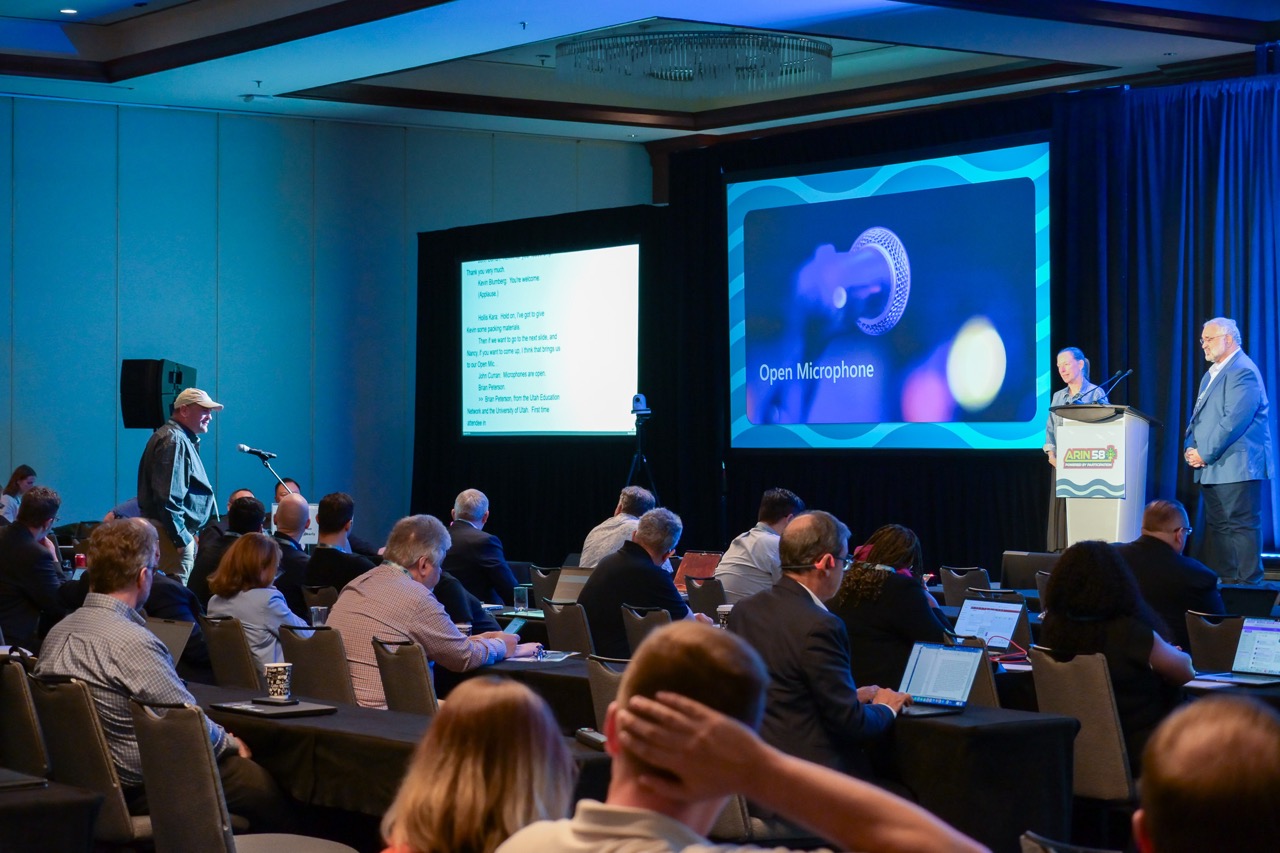
Before the meeting wrapped up for the evening, John Curran and Nancy Carter hosted an open microphone session for community members to raise questions or comments on any topic. Questions and comments touched on gratitude for the ARIN Fellowship Program, appreciation for the NRO NC’s efforts updating ICP-2 as well as recognition of the work to come, and how the Advisory Council will move forward with a vacancy in January 2027.
The community also took a moment to thank Nancy Carter for her dedication and contributions as a Trustee and Chair of the ARIN Board. John Curran honored Nancy with a curved glass plaque, saying that while he wasn’t sure what to expect when she was selected chair, “if you have the honor, the pleasure of working in a capacity with her or working for her, I would take her up on it.”
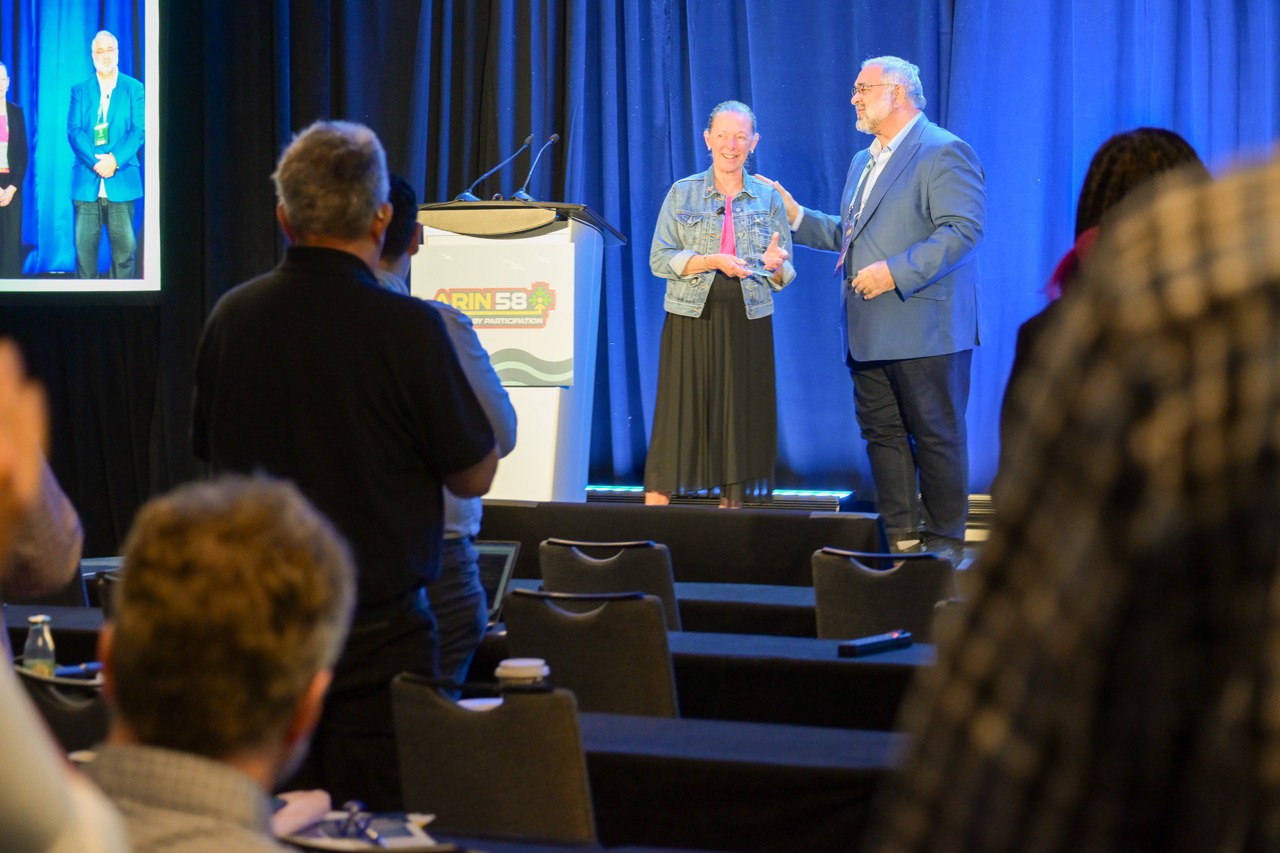
Hollis Kara then closed with final announcements, another round of thanks for our meeting sponsors, and adjournment.

Day 1, Done!
With that, we concluded day one of ARIN 58. Now we’re off to the ARIN Social tonight where we will network with our fellow meeting attendees.
If you’d like to revisit anything you’ve seen (or missed) so far, slides from today are posted on our ARIN 58 Meeting Materials page, and over the next few days, we’ll also add links to the full transcript and webcasts.
We’ll see you back here tomorrow for the second and final day of ARIN 58. Don’t forget to use the #ARIN58 hashtag and tag us @arin_rir on Instagram, @TeamARIN on X and Facebook, and @ARIN on LinkedIn when sharing your meeting experience on social media!
Taking photos or screenshots of your ARIN 58 experience? We’d love to share them with the community! Tag, reply, comment, or message us on social media or email us at social@arin.net with images (and photo credit, if needed) that you grant us permission to publish online.
Recent blogs categorized under: Public Policy
GET THE LATEST!
Sign up to receive the latest news about ARIN and the most pressing issues facing the Internet community.
SIGN ME UP →Blog Categories
Public Policy • Tips • Training • Security • Elections • ARIN Bits • Grant Program • Fellowship Program • Caribbean • IPv6 • Data Accuracy • IPv4 • Guest Post • Customer Feedback • Outreach • Internet Governance • RPKI • Updates • IRR • Business Case for IPv6