


How to Propose and Read Draft Policy at ARIN
Have you ever wondered who decides how Internet number resources are managed? At ARIN, those policies aren’t made behind closed doors. They are built through an open, transparent, community-driven system known as the Policy Development Process (PDP). Anyone can participate; you don’t even need to be an ARIN customer or member.
The policies that govern how ARIN carries out its mission as a Regional Internet Registry are proposed, discussed, and refined by the Internet community, including network engineers, researchers, industry professionals, and other interested individuals. Whether you want to streamline IPv6 adoption or update how resources are allocated, your voice helps shape ARIN’s Number Resource Policy Manual (NRPM).
Getting involved is easier than you might think. It starts with understanding how to put together a policy proposal and how to follow the Draft Policies currently under discussion.
Step One: Write Your Policy Proposal
Any member of the Internet community can submit a policy proposal. The only exceptions are members of the ARIN Board of Trustees and ARIN staff. The easiest place to start is ARIN’s online Policy Proposal Template, an interactive form that formats your proposal as you fill it out. When you’re finished, copy the text or use the built-in email button to send it to policy@arin.net. Prefer to work offline? A standalone text version of the template is also available.
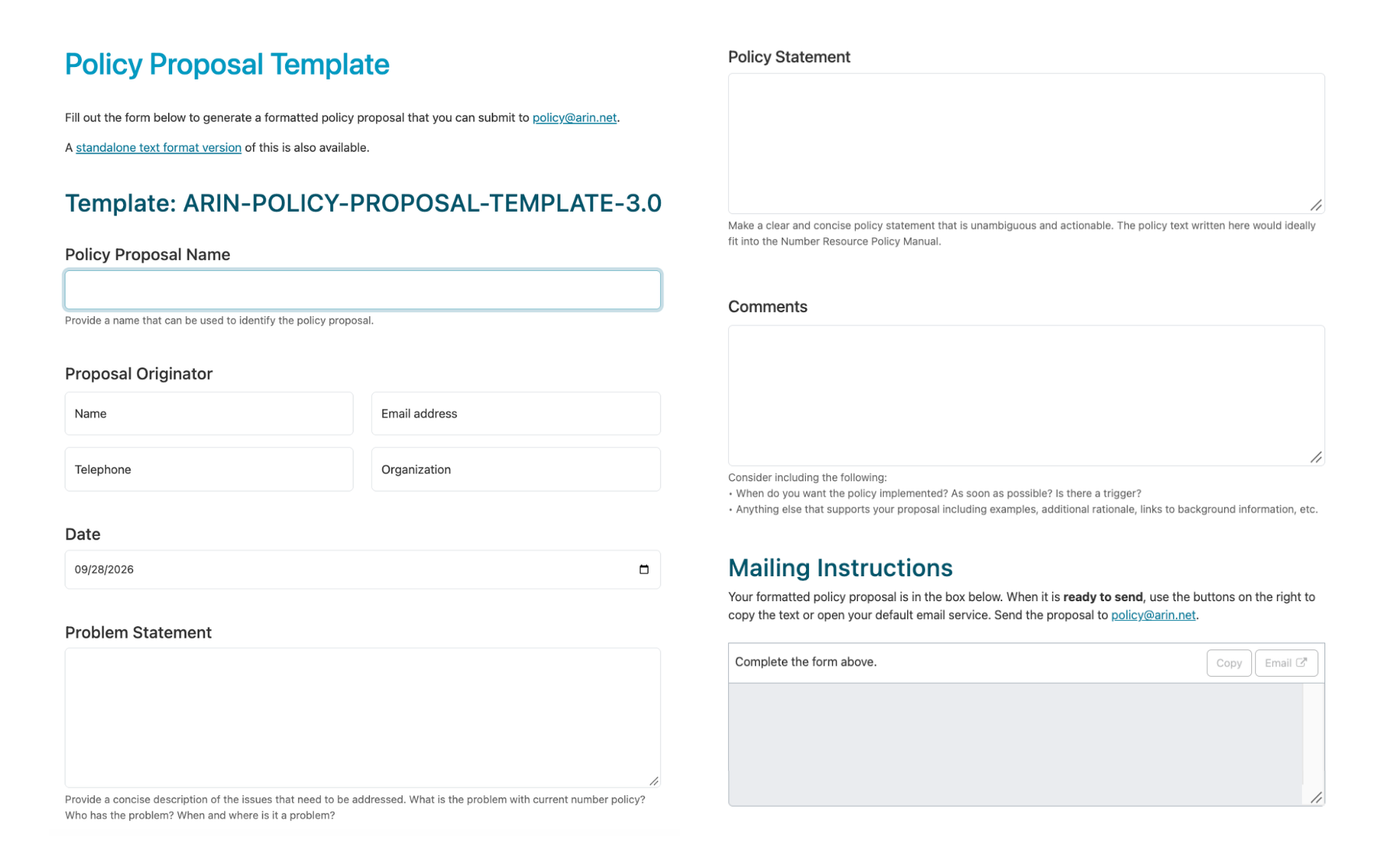
Here’s what the template asks for:
- Policy proposal name. Give your submission a descriptive working title. This is how your proposal will be identified before it receives an official docket number.
- Your contact information. Because ARIN policy development is fully transparent, we do not accept anonymous proposals. Include your full name, email address, telephone number, and organization or affiliation.
- Problem statement. Clearly define the issue: what the problem is with current policy (or whether it’s a new issue), how the issue affects the ARIN community, and where the problem exists.
- Policy statement. This is your proposed solution. Share the exact wording changes you want made to the NRPM, and note whether you are adding new text, modifying an existing section, or removing language that is no longer relevant.
- Comments. This section is optional but helpful. Use it to suggest when the policy should be implemented and to share examples, additional rationale, or links to background information.
Don’t worry if you aren’t a policy expert. The ARIN Advisory Council (AC), whose job it is to shepherd proposals and Draft Policies through the PDP, will help you refine your text.
Step Two: Work With the Advisory Council
When ARIN receives your proposal, it is forwarded to the AC, and the AC Chair assigns one or more shepherds who will reach out to you. The shepherds work with you to make sure your proposal is clear and in scope for the PDP. If it meets those criteria, the AC can accept it as a Draft Policy.
Once accepted, your proposal is assigned an official Draft Policy number and receives its own page in ARIN’s Draft and Recommended Draft Policies directory.
How to Read a Draft Policy Page
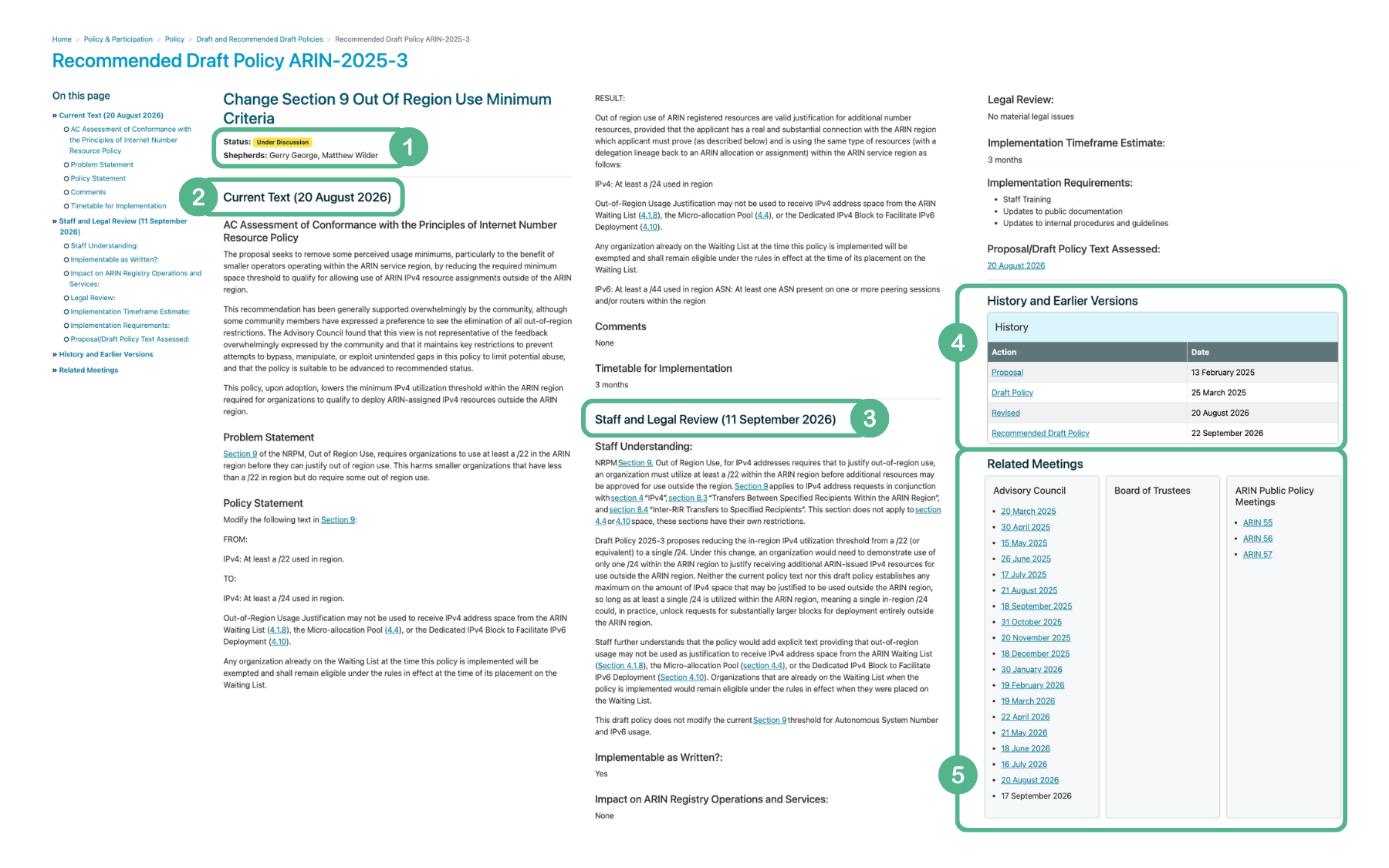
Each Draft Policy page tells the full story of a policy in one place. Here’s what you’ll find:
- Status. At the top of the page, you’ll see where the policy currently stands in the development process, such as Under Discussion, Last Call, Pending Board Review, or Implemented. You’ll also see the AC shepherds assigned to it.
- Current text. The most recent version of the policy language, including the problem statement, policy statement, and proposed timetable for implementation. As a policy matures, this section also includes the AC’s assessment of how it conforms with the Principles of Internet Number Resource Policy.
- Staff and legal review. ARIN staff’s evaluation of the policy, including whether it can be implemented as written, how it would affect registry operations, any legal concerns, and an estimated implementation timeframe.
- History and earlier versions. A chronological log of every milestone, from the original proposal submission to its acceptance as a Draft Policy and each text revision. Entries link to the related posts on the Public Policy Mailing List (PPML), so you can read the community discussion as it unfolded.
- Related meetings. Links to the AC meetings, Board of Trustees meetings, and Public Policy and Members Meetings where the policy has been discussed.
As a Draft Policy develops, the AC may advance it to a Recommended Draft Policy, meaning it is ready for final community comment at a Public Policy and Members Meeting. From there, it can move to Last Call and then to the Board of Trustees for adoption.
Where the Conversation Happens
Draft Policies are discussed by the community on the PPML, where you can share your opinion and make suggestions at any time. When you post, ensure the Draft Policy number is included in the subject line; the easiest way to do this is to reply to the original discussion thread started by ARIN staff for that policy. Then, open your message with a clear statement of support or nonsupport. This helps others follow the discussion and makes your position clear.
Draft Policies are also discussed live at ARIN’s Public Policy and Members Meetings, which are held twice a year, each spring and fall, in person and online.
No proposal? No problem.
You don’t have to write a proposal to make an impact. You can start small by:
- Subscribing to the PPML to follow Draft Policies and share your perspective.
- Attending a Public Policy and Members Meeting, either virtually or in person, to listen, share feedback, and participate in straw polls on Draft Policies.
Join Us at Our Next Public Policy and Members Meeting
ARIN’s Public Policy and Members Meetings are free to attend and open to everyone, whether you join us in person or online. They’re one of the best ways to see the PDP in action, hear directly from the AC, and help build consensus on the policies under discussion. If you plan to submit comments, ask questions, or vote in policy polls, be sure to register first.
The Internet’s future is shaped by the people who show up. Join us at our next Public Policy and Members Meeting and add your voice to the conversation.

Recent blogs categorized under: Public Policy
GET THE LATEST!
Sign up to receive the latest news about ARIN and the most pressing issues facing the Internet community.
SIGN ME UP →Blog Categories
Public Policy • Tips • Training • Security • Elections • ARIN Bits • Grant Program • Fellowship Program • Caribbean • IPv6 • Data Accuracy • IPv4 • Guest Post • Customer Feedback • Outreach • Internet Governance • RPKI • Updates • IRR • Business Case for IPv6