


Bridging Policy and Operations: An ARIN 57 Fellowship Experience
Attending ARIN 57 as a Fellow gave me the opportunity to engage directly with the leaders, operators, engineers, researchers, and policy contributors who help shape the future of Internet infrastructure, routing security, and number resource governance. The week was both professionally rewarding and personally meaningful, and it left me with a clearer view of how policy and operations come together to keep the Internet resilient.
A consistent thread throughout the meeting was that Internet number resource policy, routing security, and operational execution are increasingly interconnected. Discussions about IPv4, IPv6, Resource Public Key Infrastructure (RPKI), Autonomous System Provider Authorizations (ASPAs), and emerging areas such as space networking reinforced that long-term Internet resilience depends on aligning policy evolution with operational reality.
Bridging Policy and Operational Reality
The Fellowship pre-meeting sessions, paired with mentorship from members of the ARIN Advisory Council, helped bridge the gap between reading the Number Resource Policy Manual and understanding how policy is shaped, debated, and refined in practice.
During the meeting, I took part in discussions on routing security, particularly around how RPKI and ASPA can strengthen trust in interdomain routing. My focus was on the operational side of adoption: how providers, higher education networks, government organizations, and enterprises can implement routing security guardrails in a way that is scalable, measurable, and practical for real networks.
Several conversations across the week reinforced how difficult it can be for operators to scale validation and policy consistently across large, distributed environments without adding unnecessary operational burden. Routing security is not only a technical challenge — it is a coordination challenge that requires shared understanding across policy, engineering, and operations teams.
Routing Security, Automation, and AI-Assisted Validation
I also participated in conversations on how automation and AI-assisted validation could improve routing security outcomes. As RPKI, ASPA, and related mechanisms continue to mature, operators will need better ways to validate policy intent, detect configuration drift, identify inconsistent route-origin or AS-path behavior, and reduce manual review overhead.
My perspective is that AI and automation can support these goals while preserving human oversight, auditability, and operational guardrails. The objective is not to remove operators from the loop — it is to give them better tools to focus their attention on the decisions that genuinely require human judgment and to handle the repetitive, high-volume validation work in a more consistent and traceable way.
Rethinking How Policy Evolves
Another area I found especially important was the opportunity to brainstorm how policy development itself could evolve. Today, much of ARIN’s Policy Development Process (PDP) still depends heavily on mailing lists and meeting-based discussion. These channels remain valuable, and they have served the community well, but there may be opportunities to complement them with more structured, DevOps-inspired workflows.
For example, version-controlled policy text, transparent change history, community review workflows, and CI/CD-style validation could make policy evolution easier to track, compare, and operationalize over time. The same disciplines that have transformed how operators manage configurations and infrastructure could, applied carefully, help the policy community move faster while preserving the openness and rigor that make the bottom-up process work.
Community, Connection, and Continued Engagement
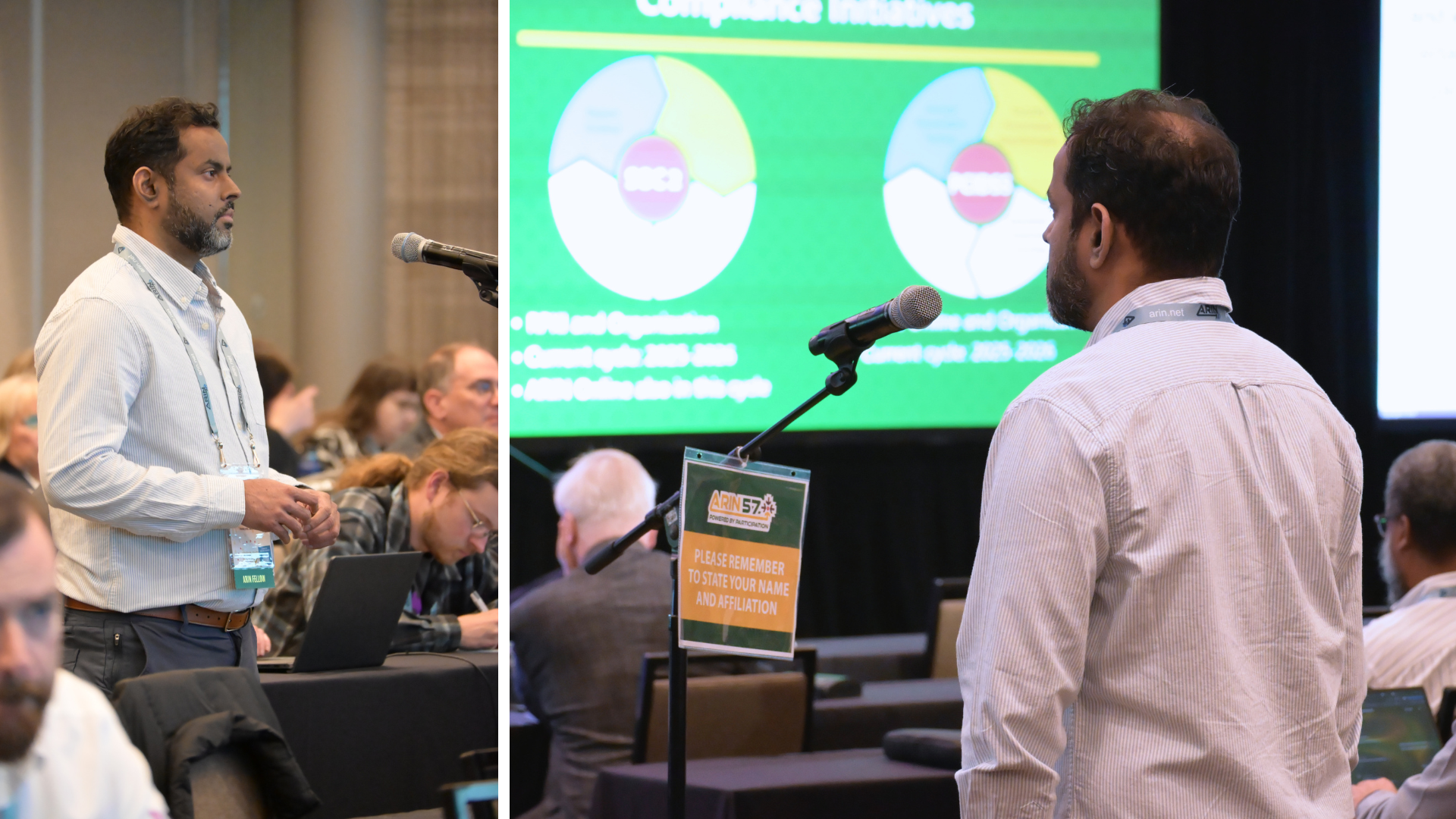
The Fellowship gave me firsthand exposure to the PDP. Participating in workshops, engaging in policy discussions, and stepping up to the microphone helped me understand how community-driven Internet governance works in practice. I appreciated the openness of the ARIN community and the chance to contribute from the perspective of a practitioner focused on network architecture, automation, and operational resilience.
Equally valuable was the opportunity to connect with peers across service providers, higher education, government, enterprise, and the broader operator community. Several conversations reinforced how much shared ground exists between organizations that, on paper, look very different. The challenges around scaling routing security, maintaining policy consistency, and aligning operations with governance are common — and the Fellowship was a reminder of how much value comes from working through them together.
Overall, the ARIN Fellowship Program strengthened my understanding of Internet governance and policy development, and it gave me a meaningful forum in which to contribute ideas around routing security, automation, AI-assisted validation, and modernized policy workflows. I am grateful to ARIN, the Fellowship Selection Committee, the Mentors, and the program organizers for creating an inclusive and collaborative environment, and I look forward to continuing my participation in ARIN policy discussions and contributing to the resilience of Internet infrastructure.
Ready to experience the ARIN Fellowship for yourself? The application period for the ARIN 58 program runs from 6 July through 19 July! For details and application instructions, visit our Fellowship Program page.

Any views, positions, statements, or opinions of a guest blog post are those of the author alone and do not represent those of ARIN. ARIN does not guarantee the accuracy, completeness, or validity of any claims or statements, nor shall ARIN be liable for any representations, omissions, or errors contained in a guest blog post.
Recent blogs categorized under: Fellowship Program
GET THE LATEST!
Sign up to receive the latest news about ARIN and the most pressing issues facing the Internet community.
SIGN ME UP →Blog Categories
Public Policy • Tips • Training • Security • Elections • ARIN Bits • Grant Program • Fellowship Program • Caribbean • IPv6 • Data Accuracy • IPv4 • Guest Post • Customer Feedback • Outreach • Internet Governance • RPKI • Updates • IRR • Business Case for IPv6