



ARIN 57 Day 2 Recap

Welcome back for your day two recap of the ARIN 57 Public Policy and Members Meeting in Louisville, Kentucky, and online via Zoom. Today’s highlights included discussions of six Draft Policies, reports from ARIN Community Grant recipients, and presentations by ARIN staff. Thanks to everyone who has joined us so far — we’ll see you again tomorrow at 9 AM ET for the final day of the meeting.
If you wish to participate in the meeting proceedings, it’s still not too late to register.
Starting Things Off
To open the day, Director of Communications Hollis Kara welcomed all attendees, encouraged active participation in the policy discussions, introduced the day two agenda, and recognized our meeting sponsors,
Engineering, Security, and Routing
Chief Technology Officer Mark Kosters kicked off the morning’s technical segment with the Engineering Update. Mark highlighted the core and internal services ARIN Engineering supports — from RPKI and ARIN Online to the Internet Routing Registry (IRR), DNS, directory services, and more — and noted that ARIN is planning a community consultation later this year to consider the retirement of RWhois and Whois-RWS.
On the statistics front, ARIN Online has now had nearly 242,000 accounts activated since inception, and just over 53,000 users have adopted multifactor authentication (MFA). Mark also provided an update on the new data center, which successfully completed its move out of ARIN headquarters and into a separate facility in Northern Virginia — resolving significant technical debt, improving availability, and enabling a modernized Kubernetes-based infrastructure. Releases since ARIN 55 have included the RPKI ROA Change Log, ASPA support, and the migration of all authorization to ARIN Online, with ongoing work focused on RDAP enhancements, routing intelligence for RPKI, and continuing reduction of technical debt. Mark also took a moment to recognize Reggie Forster, ARIN’s Director of Operations, who retired this year after nearly six years at ARIN.
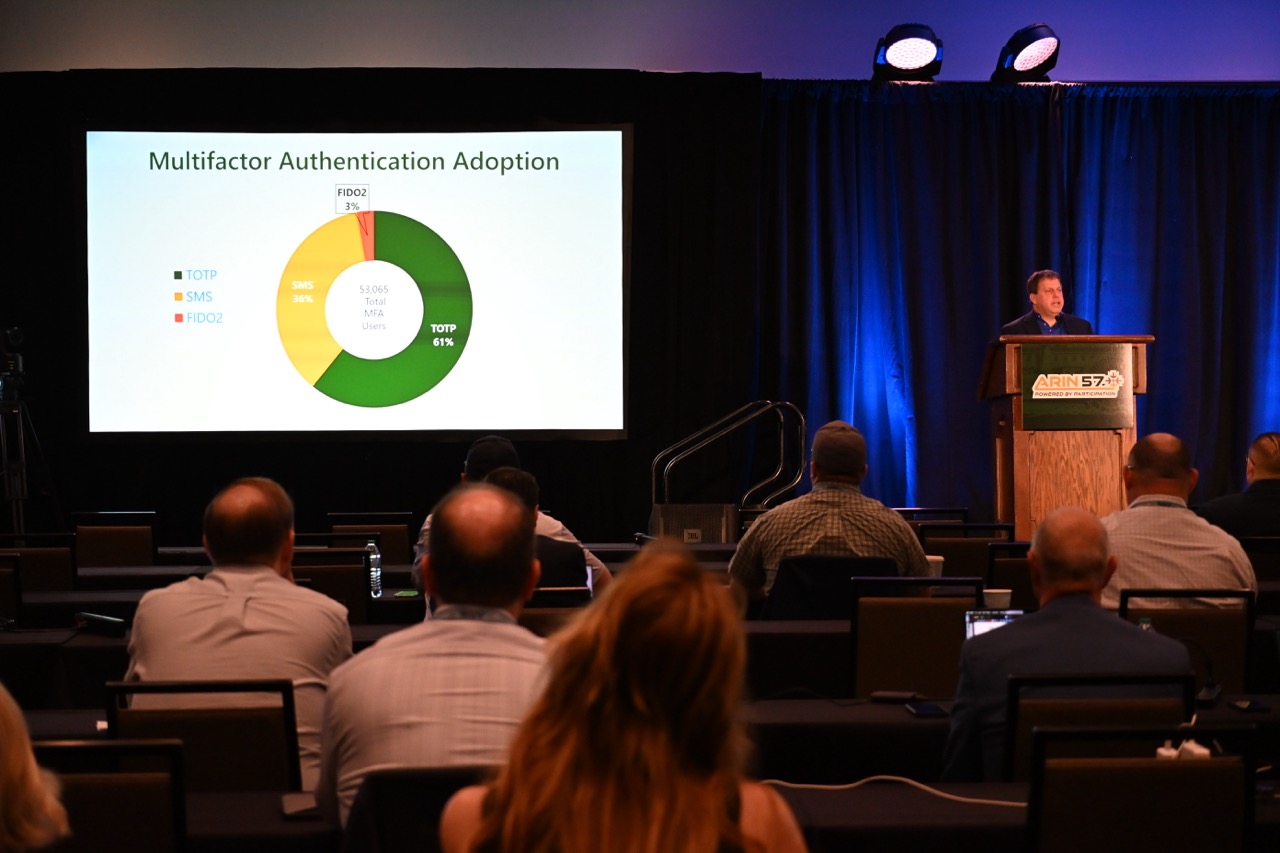
Chief Information Security Officer Christian Johnson followed with the Information Security Update. After outlining ARIN’s security philosophy, which focuses on maintaining up-to-date infrastructure, staff training, threat identification, and rapid remediation, Christian reviewed the security activities completed in 2025, including the annual penetration test, monthly vulnerability scanning and patching, 100 percent completion of annual security training, monthly phishing defense training, and ongoing SOC 2 audit work. He also highlighted upcoming initiatives, including enhanced monthly vulnerability scan reviews, monthly web malware scans of arin.net, social media monitoring, and the phased rollout of background checks for all staff. A key milestone on the horizon: ARIN’s 2026 SOC 2 audit will expand to include both RPKI and ARIN Online, reinforcing the organization’s commitment to security assurance across its most critical systems.
Christian’s presentation generated a lively discussion from both our in-person and online participants about topics including the use of artificial intelligence in cybersecurity and developments in encryption/cryptography.
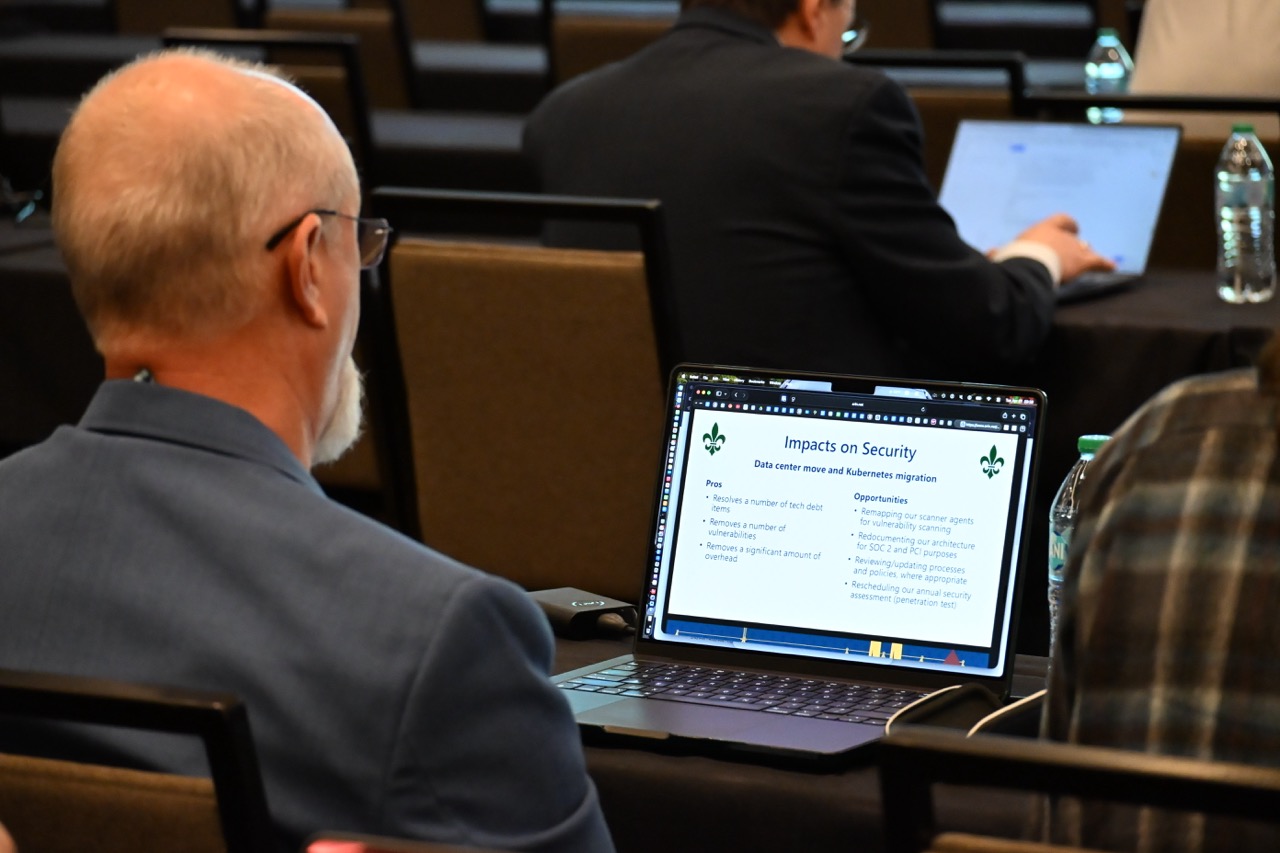
Director of Customer Technical Services Brad Gorman then shared the Routing Security Update, providing a comprehensive look at the state of RPKI globally and within the ARIN region. Key data points:
- Global RPKI validity reached 65.5 percent for IPv4 and 60.9 percent for IPv6 as of Q1 2026 — a continuing upward trend, driven by ongoing education, outreach, and service provider requirements for ROA creation.
- New RPKI registrations with ARIN have grown steadily, reaching 1,839 new registrations in 2025, up from 1,711 in 2024.
- Total RPKI adoption in the ARIN region now stands at 8,403 organizations, with 98 percent using Hosted RPKI — representing 25 percent growth since Q1 2025. However, approximately 15 percent of registered organizations have not yet created a single ROA, underscoring that signing up is only the first step.
- Resource coverage: 50 percent of RPKI-eligible IPv4 blocks in the ARIN region are now covered by ROAs, and 54 percent of ARIN-registered IPv4 blocks in Internet announcements are RPKI Valid.
- ASPAs: More than 198 Autonomous System Path Authorizations (ASPAs) have been created since ARIN launched full ASPA support, with the number trending upward as the IETF standards process continues.
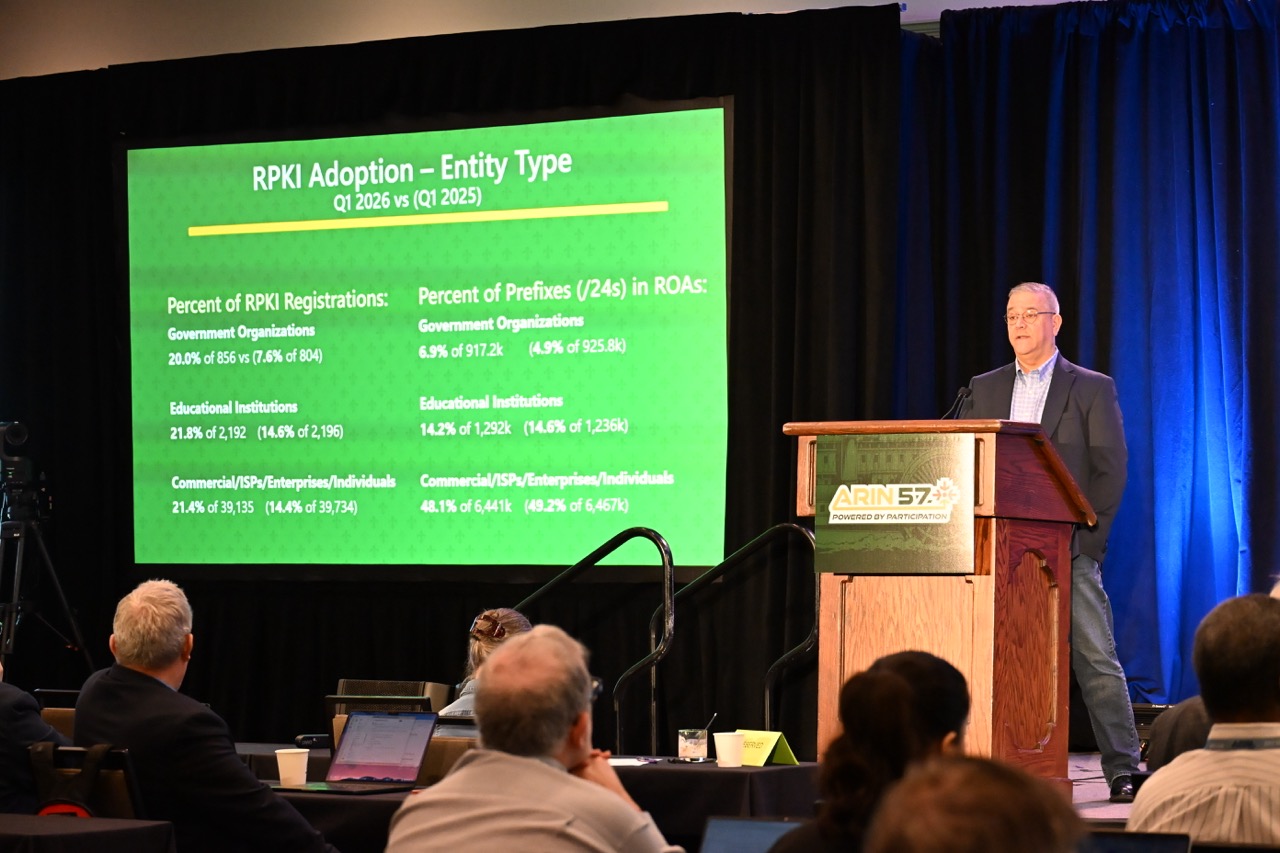
Looking ahead, Brad previewed ARIN’s upcoming RPKI Routing Intelligence feature, which will help organizations understand the real-world impact of their RPKI configurations — including what might happen if proposed changes are made, why a route might be Invalid or Not Found, and what steps can be taken to reach a Valid state.
Community Grant Program Reports
Following a short break, Senior Project Manager Amanda Gauldin opened the Community Grant Program session by reviewing its impact since launching in 2019: 26 projects have been funded at a total of US$320,975. She then introduced the three 2025 grant recipients who reported on their funded projects:
Harlan Stenn — Network Time Foundation: Harlan presented an interim report on the Network Time Foundation’s grant project, “Augmenting GNU AutoGen to Support Hugo Markdown as a Documentation Stanza Markup Format.” The NTP Project has been shipping code and documentation since 1982, and over the decades its documentation has fragmented across multiple independent silos (READMEs, man pages, HTML docs) that are difficult to keep consistent. When NTF transitioned its websites to Hugo in 2021, this created a bottleneck; AutoGen, the tool that generates NTP’s documentation in multiple formats, could not natively output Markdown, the format Hugo requires. The 2025 ARIN Community Grant is funding the addition of native Markdown generation to GNU AutoGen — eliminating the manual conversion bottleneck, reducing documentation fragmentation, and paving the way for a unified, modernized documentation future for NTF and other projects in its ecosystem. Harlan reported that Phase 1 identification is complete, with markup tags mapped and first target documentation files selected.
James Harr — Internet2: James presented an update on Internet2’s IPv6 Test Pod project. As a high-speed national research and education network (NREN) with 46 Points of Presence around the U.S. and international peerings to other NRENs, Internet2 is well positioned to tackle one of the persistent barriers to IPv6 adoption: the difficulty of setting up test environments to validate IPv6-only and IPv6-mostly networking configurations. The IPv6 Test Pod is an inexpensive device (under $150) that comes pre-configured to create multiple testing environments — dual-stack, NAT64/DNS64, IPv6-mostly, and IPv6-only — with a tunnel service included. The project, supported by a US$16,000 follow-on ARIN Community Grant (after an initial US$7,000 grant in 2023), distributed 45 units to applicants in 2025 with 20 more lined up for delivery. Notable accomplishments include successful Windows CLAT testing, NetworkManager CLAT testing, and a presentation at the 2025 ACM Internet Measurement Conference.
Read more about these projects in this blog post: Meet the 2025 ARIN Community Grant Recipients.
Matt Griswold — 20C: Matt presented an update on 20C’s project, “From Raw to Ready: Visualizing RDAP with RegCtl.” RDAP registry data today is inconsistent across RIR implementations, difficult for humans to read, and mostly accessible only through CLI tools or raw JSON. 20C’s regCtl tool addresses this by normalizing RDAP responses across registries to provide consistent data structure, normalized entities, unified object views, and API access for ASNs, IP prefixes, domains, and organizations. The ARIN Community Grant funded development of a modern web interface for regCtl that allows users to search by ASN, IP, prefix, or domain and view normalized registry data with contextual explanations of RDAP fields. The interface is open source and designed for operators, researchers, and educators.
Interested in applying for an ARIN Community Grant for your project that benefits the Internet community in the ARIN region? The 2026 application period is open now through 14 June! Visit arin.net/grants for more information and the application.
Internet Governance and Caribbean Collaboration
Shifting from technical reports to Internet community engagement, Senior Government Affairs Analyst Nate Davis provided an Internet Governance update covering ARIN’s efforts on the global stage from 2025 through 2026. He outlined the Government Affairs Department’s core mission — advocating for the Internet number registry system and the multistakeholder approach to Internet technical coordination — and recapped ARIN’s participation in forums including the Internet Governance Forum, WSIS+20 Review, CITEL, the Caribbean Telecommunications Union, and the ITU. Nate highlighted several favorable recent outcomes, including the WSIS+20 Review’s continued recognition of the technical community as a key stakeholder, the ITU’s adoption of a resolution supporting IPv6 deployment in developing countries (WTDC Resolution 63), and ARIN’s ongoing participation in the ITU Partner2Connect program, through which ARIN annually pledges support aligned with its Fellowship Program, Community Grant Program, and regional outreach activities.
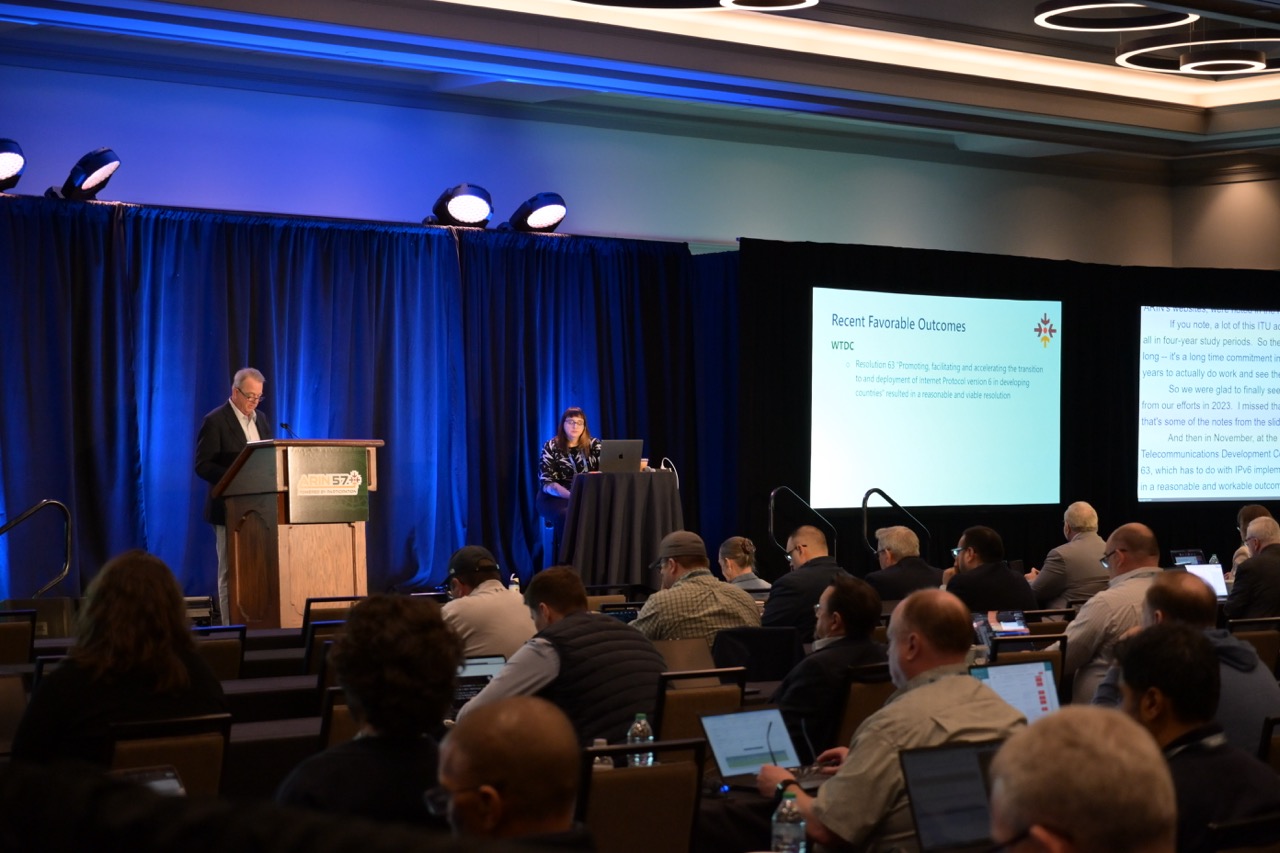
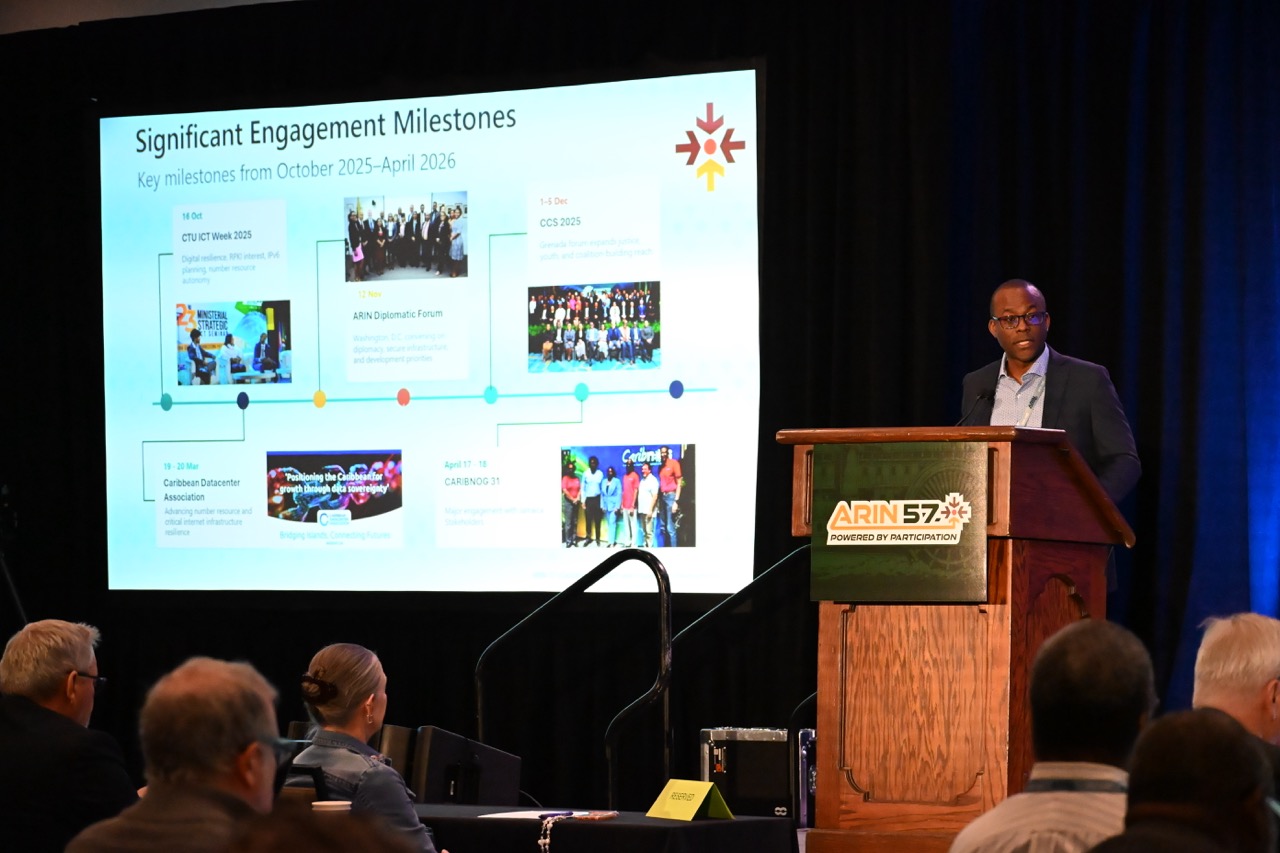
Director of Caribbean Affairs Bevil Wooding then delivered the Caribbean Collaboration update, reflecting on ARIN’s evolving outreach strategy in the Caribbean from October 2025 through April 2026. Bevil highlighted a series of significant engagement milestones: the Caribbean Telecommunications Union ICT Week in October 2025, ARIN’s Diplomatic Forum in Washington, D.C., in November, the Caribbean Computer Society (CCS) 2025 forum in Grenada in December, participation with the Caribbean Datacenter Association in March 2026, and CaribNOG 31 in Jamaica in April 2026. He noted that the region’s conversations are increasingly centered on three broad shifts:
- Hot topics including digital resilience, digital sovereignty, cybersecurity, regulatory harmonization, and artificial intelligence
- A tech community hot list focused on Internet exchange points, IPv6, Autonomous System Numbers (ASNs), routing security, data privacy, and cyber readiness
- Geopolitics, with external developments driving increasing calls for practical Caribbean coordination on security, routing resilience, and technical capacity
ARIN’s outreach strategy has evolved to reach government, regulatory, diplomatic, and youth-facing spaces, with the goal of converting visibility into repeat participation and meaningful policy engagement and with a deliberate build toward ARIN 58 in Miami as the next major regional opportunity.
Lunch and Table Topics
During the lunch break, in-person attendees had the opportunity to gather and discuss topics of interest with Advisory Council Working Group members:
- The Policy Engagement Working Group hosted a discussion on improving the policy engagement experience, led by Alicia Trotman and Matthew Wilder
- The NRPM Working Group hosted a discussion on the future of ARIN IPv4 allocated space, led by Brian Jones and Lily Botsyoe
- The Policy Experience Report Working Group hosted a discussion on Section 6 IPv6 allocations, led by Elizabeth Goodson, Gus Reese, and Alison Wood.

Policy Block
After lunch, the meeting moved into its policy block, the heart of every ARIN Public Policy and Members Meeting. AC members presented the following six Draft Policies, and ARIN Board of Trustees Chair Nancy Carter opened the floor for community members to provide input and ask questions:
- Draft Policy ARIN-2025-1: Clarify ISP and LIR Definitions and References to Address Ambiguity in NRPM Text (PDF) — presented by Leif Sawyer
- Draft Policy ARIN-2025-3: Change Section 9 Out Of Region Use Minimum Criteria (PDF) — presented by Gerry George
- Draft Policy ARIN-2025-6: Fix Formula in 6.5.2.1c (PDF) — presented by William Herrin
- Draft Policy ARIN-2025-7: Make Policy in 6.5.8.2 Match the Examples (PDF) — presented by Lily Botsyoe
- Draft Policy ARIN-2025-8: Reserve 4.10 Space for In-Region Use (PDF) — presented by E. Marie Brierley
- Draft Policy ARIN-2026-1: Taking IP To Other Planets (TIPTOP) (PDF) — presented by Alison Wood
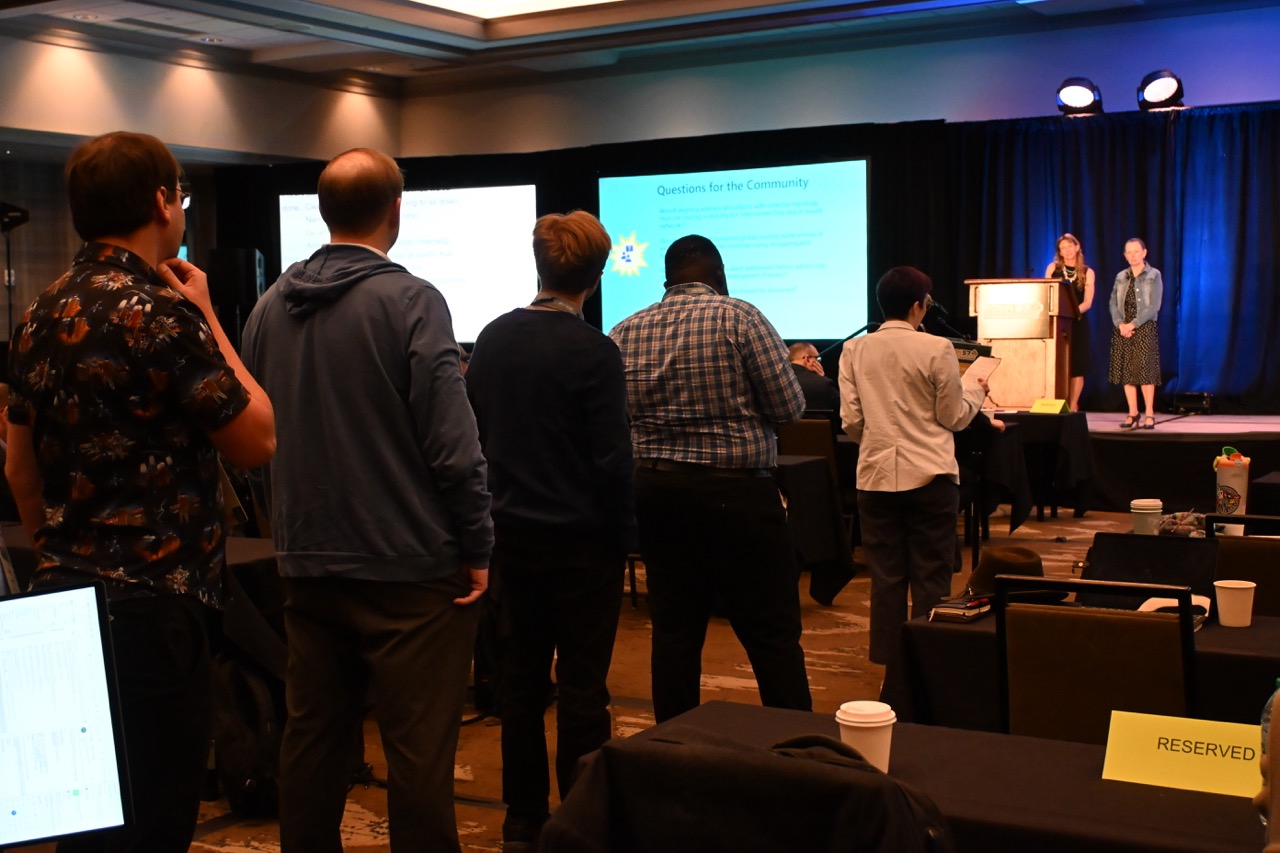
The six Draft Policies provoked robust discussion amongst attendees, especially around the operation of IP-based networking in outer space. The enthusiastic engagement on policy took us through the end of the day, so we did not have time to share the recorded presentations provided by our fellow RIRs. We appreciate their contributions of updates for ARIN 57 and will post these recordings to the Meeting Materials page for the community to view.
Thank you to all who raised questions and shared their perspectives in support of ARIN’s Policy Development Process! You can continue the conversation on the Public Policy Mailing List (PPML).
Open Microphone and Closing
ARIN President and CEO John Curran and Nancy Carter hosted a lively open mic session at the end of the day and fielded comments on topics ranging from a Louisville local’s appreciation for the ARIN community to encouragement to step up to the microphone at meetings and the prospect of “omnibus” policy changes. Hollis Kara closed with final announcements and adjournment to conclude day two of ARIN 57.
A Home Run Event
Last night, in-person attendees had the opportunity to socialize with each other, continue discussions sparked by the meeting, and explore the Louisville Slugger Museum and Factory at the ARIN 57 social event.

See You Tomorrow
With day two of ARIN 57 complete, we head into our final morning tomorrow. All slides from today have been posted on our ARIN 57 Meeting Materials page. Join us back here at 9 AM ET for a shorter but equally packed day three — featuring department reports, an election preview, and more.
Please keep the conversation going with the #ARIN57 hashtag, and tag us @arin_rir (Instagram), @TeamARIN (Facebook, X), or @ARIN (LinkedIn) when sharing your meeting experience on social media!
Taking photos or screenshots of your ARIN 57 experience? Tag, reply, comment, or message us on social media, or email us at social@arin.net with images (and photo credit, if needed) that you grant us permission to publish online.
Recent blogs categorized under: Public Policy
GET THE LATEST!
Sign up to receive the latest news about ARIN and the most pressing issues facing the Internet community.
SIGN ME UP →Blog Categories
Public Policy • Tips • Training • Security • Elections • ARIN Bits • Grant Program • Fellowship Program • Caribbean • IPv6 • Data Accuracy • IPv4 • Guest Post • Customer Feedback • Outreach • Internet Governance • RPKI • Updates • IRR • Business Case for IPv6