


ARIN 57 Day 1 Recap

Greetings from Louisville, Kentucky — home of the Louisville Slugger, the Kentucky Derby, and, just this past weekend, the spectacular Thunder Over Louisville fireworks display that lit up the Ohio River skyline. We’re thrilled to welcome both new and familiar faces joining us here in the Derby City and online for a packed lineup of policy discussions, organizational updates, guest speakers, and more. Read on for a summary of what has happened so far at ARIN 57.
Want to join in the discussions remotely? Register before tomorrow so we can invite you to the Zoom webinar.
Deep Dive and River Views
Yesterday afternoon, we kicked off the week’s activities with an RPKI Deep Dive workshop. In-person attendees had the opportunity to get hands-on experience with ARIN’s Resource Public Key Infrastructure tools, creating Route Origin Authorizations (ROAs) and Autonomous System Provider Authorizations (ASPAs) with guidance from ARIN’s Director of Customer Technical Services, Brad Gorman.
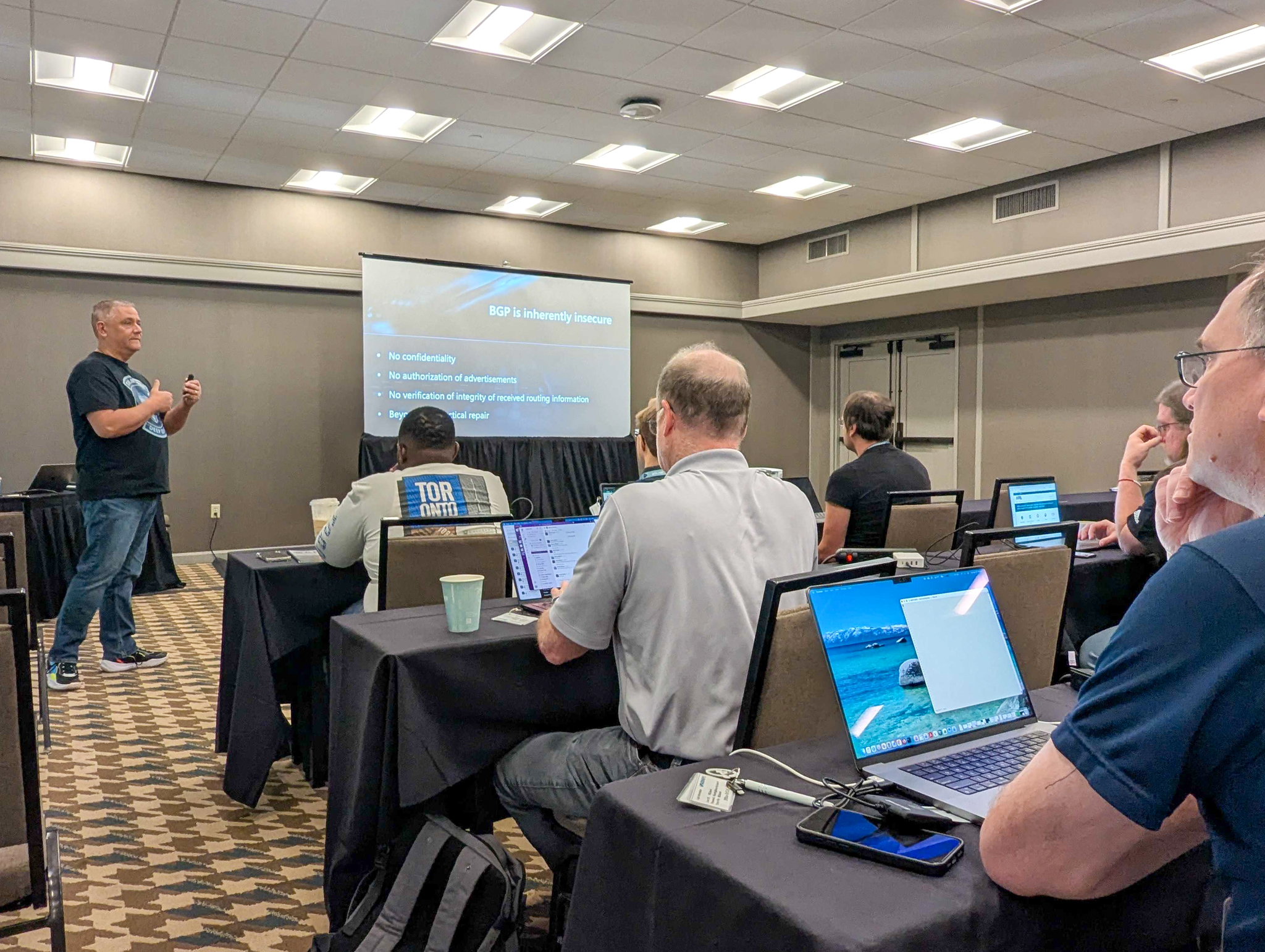
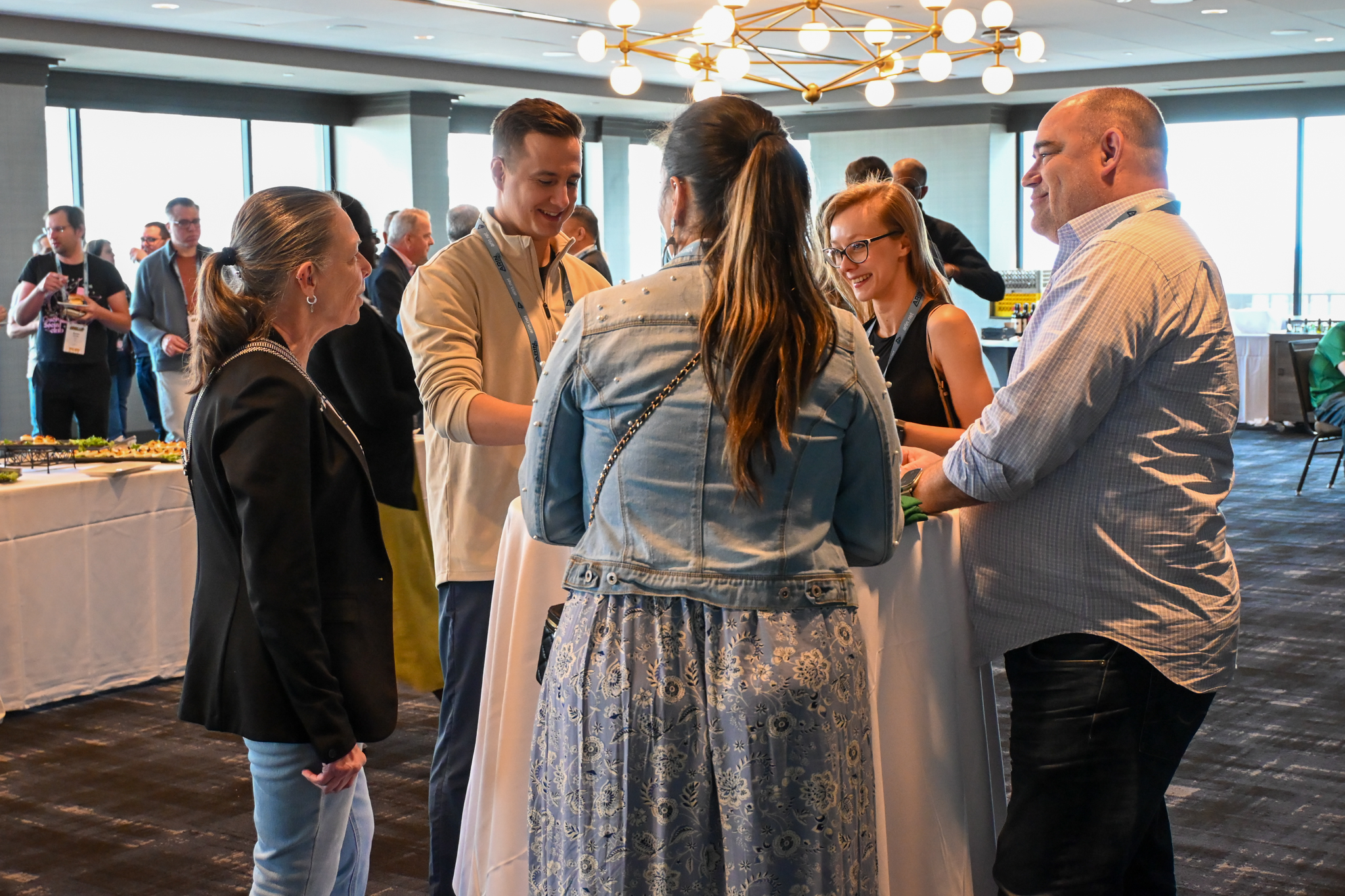
Brad led attendees through the ins and outs of ARIN’s hosted RPKI: its purpose, its key components, and the steps to get started. After the workshop, meeting attendees gathered at the Welcome Reception for a chance to connect with colleagues before the full ARIN 57 agenda got underway this morning.
Opening the Day
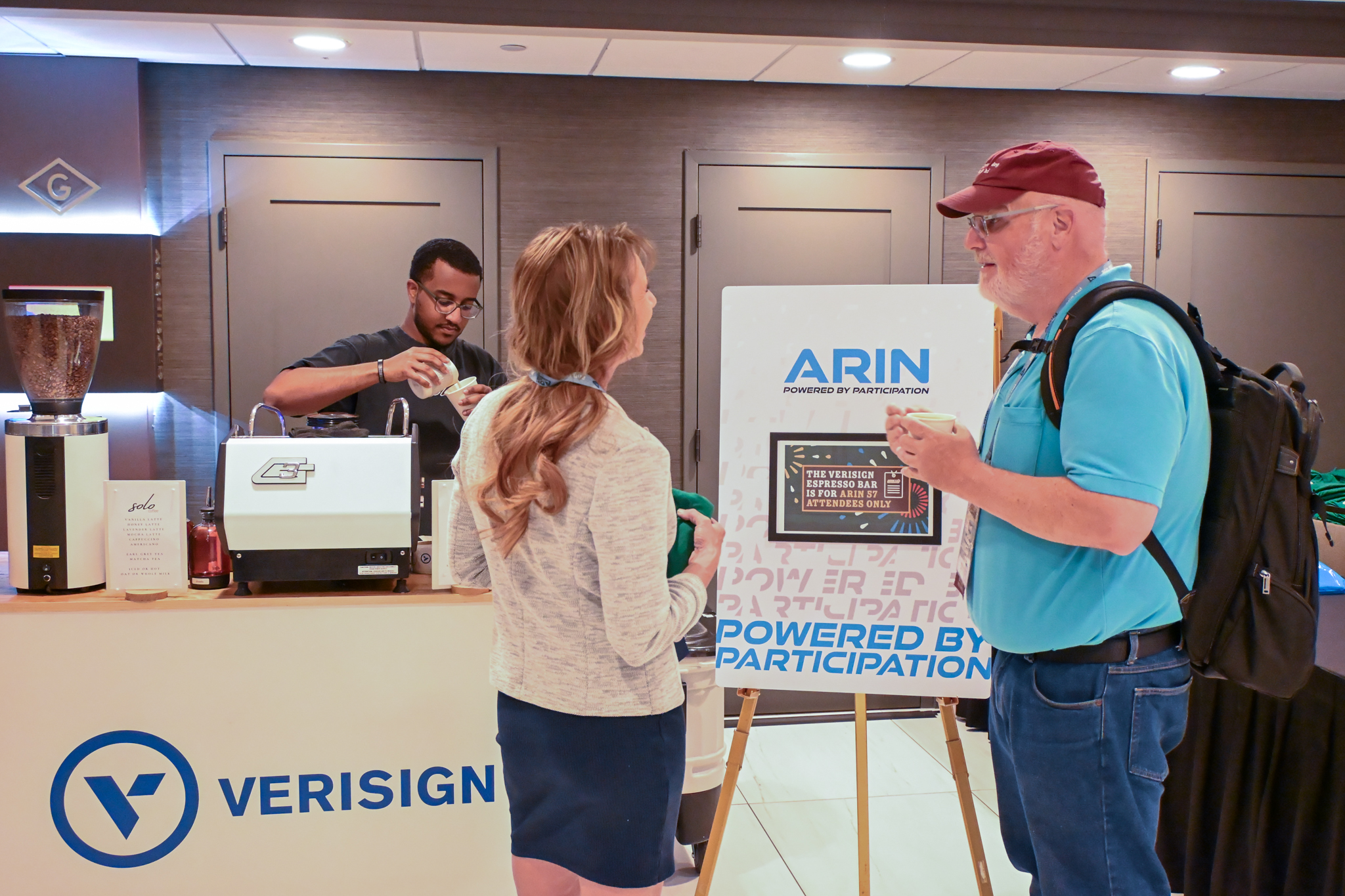
As Monday dawned with partly sunny skies and cool spring air, we began the first official day of the meeting. Director of Communications Hollis Kara got us started with opening announcements, introductions of our Board of Trustees, Advisory Council (AC), and the Number Resource Organization Number Council (NRO NC), and an overview of the meeting agenda. She also extended thanks to our ARIN 57 sponsors — network sponsor Spectrum, platinum sponsor Amazon Web Services, silver sponsor IPXO, and espresso bar sponsor Verisign — for their support in making ARIN 57 possible.
Hollis then reviewed ARIN’s Standards of Behavior before welcoming back ombudsperson Stacy Goodwin Lightfoot of Hinton & Company, who introduced herself and spoke about her role in helping make the ARIN 57 meeting a safe and welcoming space for all participants.
ARIN President and CEO John Curran offered opening remarks, highlighting ARIN’s role administering a registry on behalf of the community. “That’s our purpose,” he said. “We need these meetings to make sure we’re doing a good job of that, that we’re following your directions.”
“This really is your registry,” he continued. “We’re running it on your behalf. And it’s important for you to participate to make sure we’re doing your registry the way you want. … Our whole management team is here to engage with, as well as the Board members that you saw and the Advisory Council members. If you have a question, don’t hesitate, just ask someone, ‘How can I get this idea done?’ We welcome all the ideas from everyone; it’s very important. We need your input.”
Nancy Carter, Chair of the Board of Trustees, added her own welcome and echoed the invitation to connect directly with ARIN staff and leadership throughout ARIN 57.
“The Board of Trustees doesn’t just exist because the law says we must. We exist to be ARIN’s conscience and its compass,” she said. “Our goal is to direct and protect so that leadership can focus on doing. So remember we’re your representatives. Our oversight is strongest when we know your perspectives.”
Governance and Finances
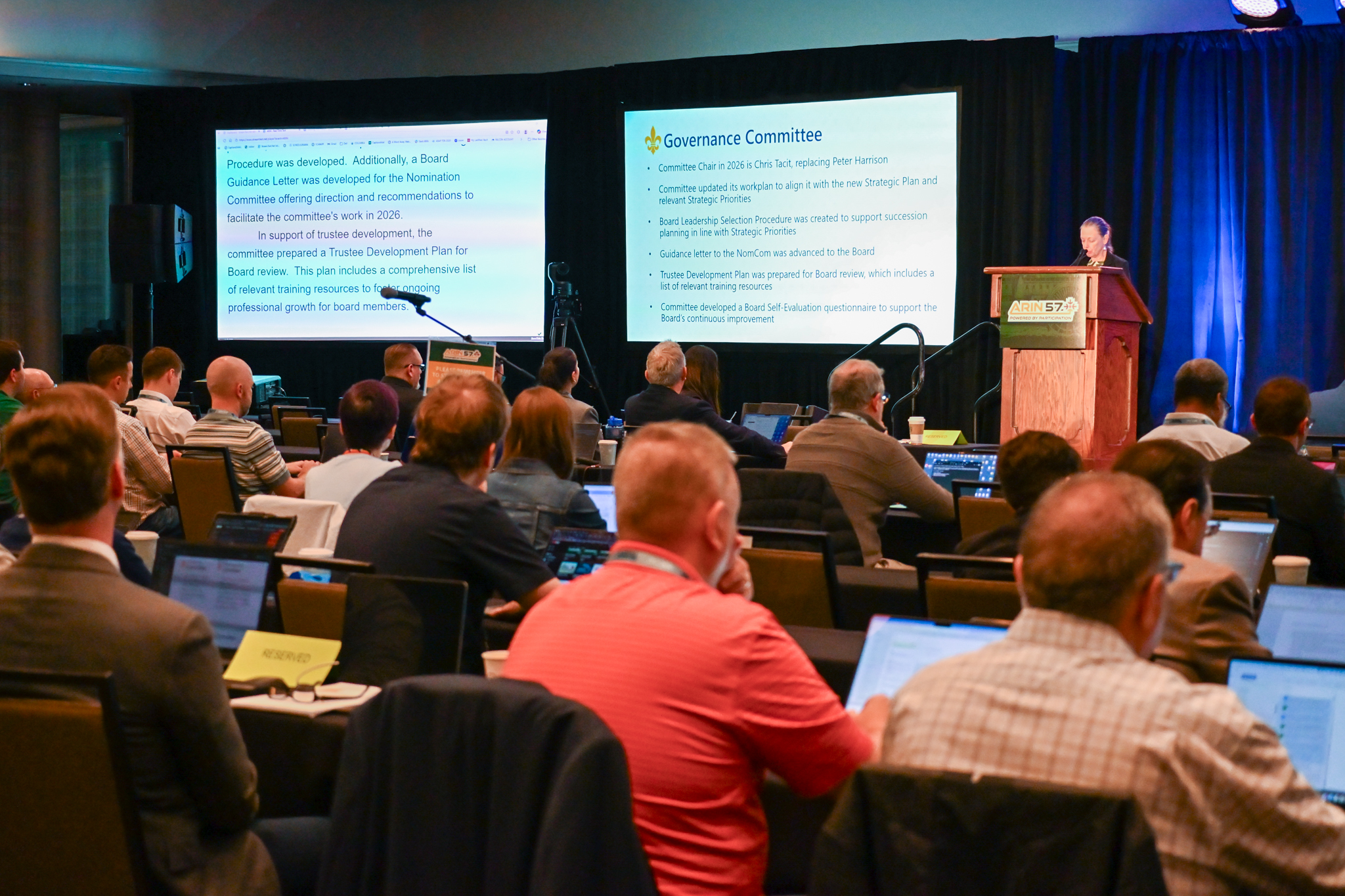
Nancy stayed at the podium to kick off the morning’s presentations with the Board of Trustees Report, which covered the Board’s financial and fiduciary actions since ARIN 56. Highlights included the Board’s approval of the 2026 budget and renewal of ARIN’s existing office lease, the election of Board officers and appointment of all Standing Committee members, and the endorsement of the ARIN Strategic Plan for 2025–2028. The plan is organized around four priorities: Global Leadership; Governance and Organizational Resilience; Member Experience and Advocacy; and Operational and Technical Excellence. Nancy also noted that the Nomination Committee developed a new trustee candidate recruitment guide aligned with those strategic priorities.
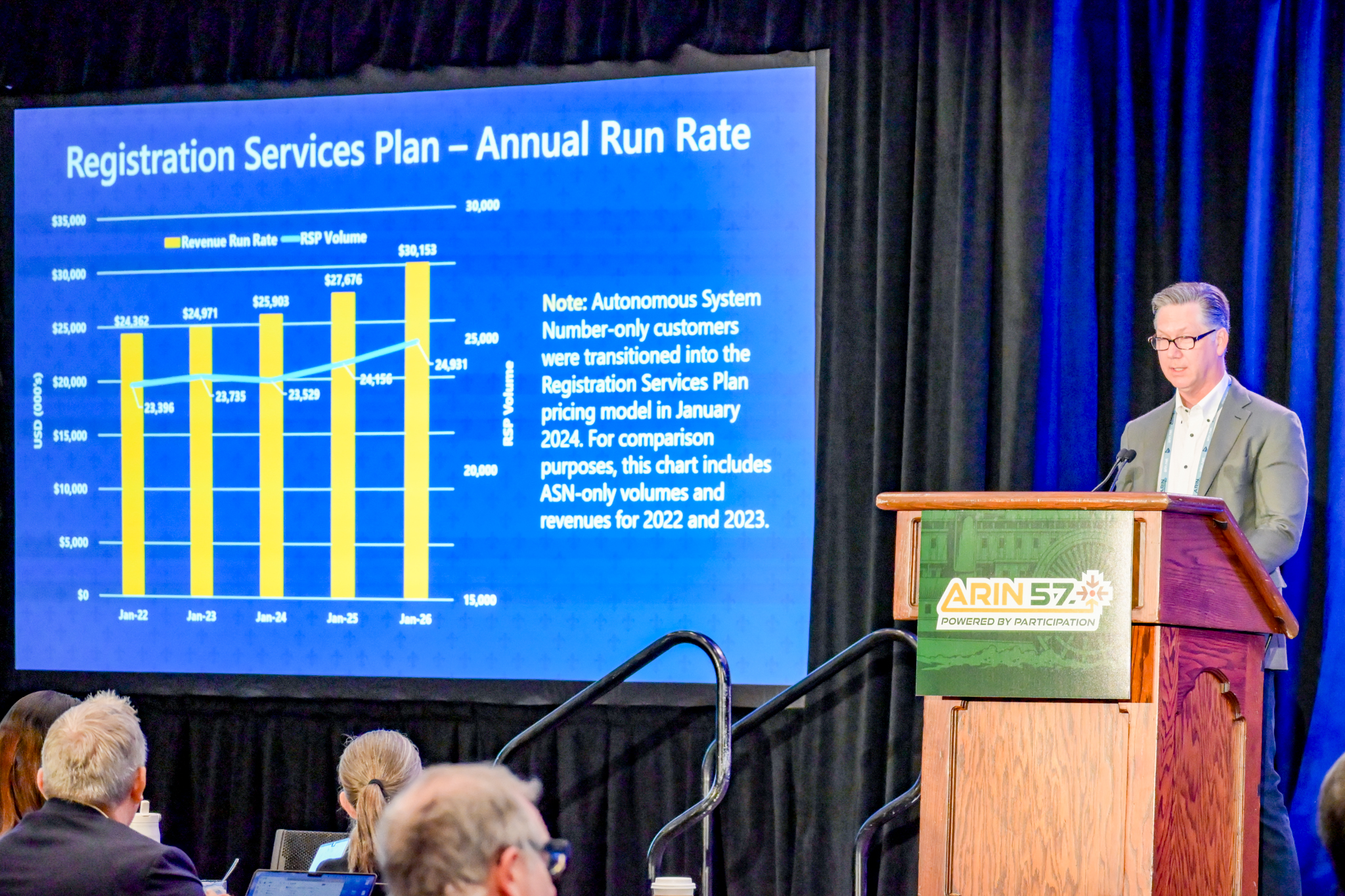
Up next, Board Treasurer Hank Kilmer delivered the Financial Report. He provided an overview of Finance Committee activity since ARIN 56 along with updates on ARIN’s financial performance and positions, revenues, operating expenses, and investments. Hank reported that the 2025 Data Center Project came in within its approved budget and that ARIN’s office lease renewal was finalized, keeping headquarters at its current location with favorable terms. Looking ahead, Hank outlined ARIN’s long-term financial plan, which aims to achieve a balanced budget by 2030 through annual Registration Services Plan price increases of up to 5 percent and disciplined spending management.
Guest Speaker: Demystifying RPKI
With the organizational business of the morning complete, ARIN 57 welcomed its first keynote speaker, Internet2 Director of Routing Integrity Steve Wallace, for the presentation “Demystifying RPKI: Exploring Tools to Simplify ROA Planning and Visualize Validation.”
Steve introduced three interconnected tools developed through a collaboration between CAIDA.org and Internet2 with support from the National Science Foundation:
- The RPKI-ROA Planner, which helps operators create ROAs more safely by presenting candidate ROAs based on IRR route objects, currently observed Internet routes, and historical routing data
- The RPKI-ROA Visualizer, which walks through bit by bit how a given ROA covers a BGP route and how Route Origin Validation works
- An experimental RPKI-ASPA Planner, which uses CAIDA AS relationship data to suggest a possible Autonomous System Provider Authorization for a given ASN
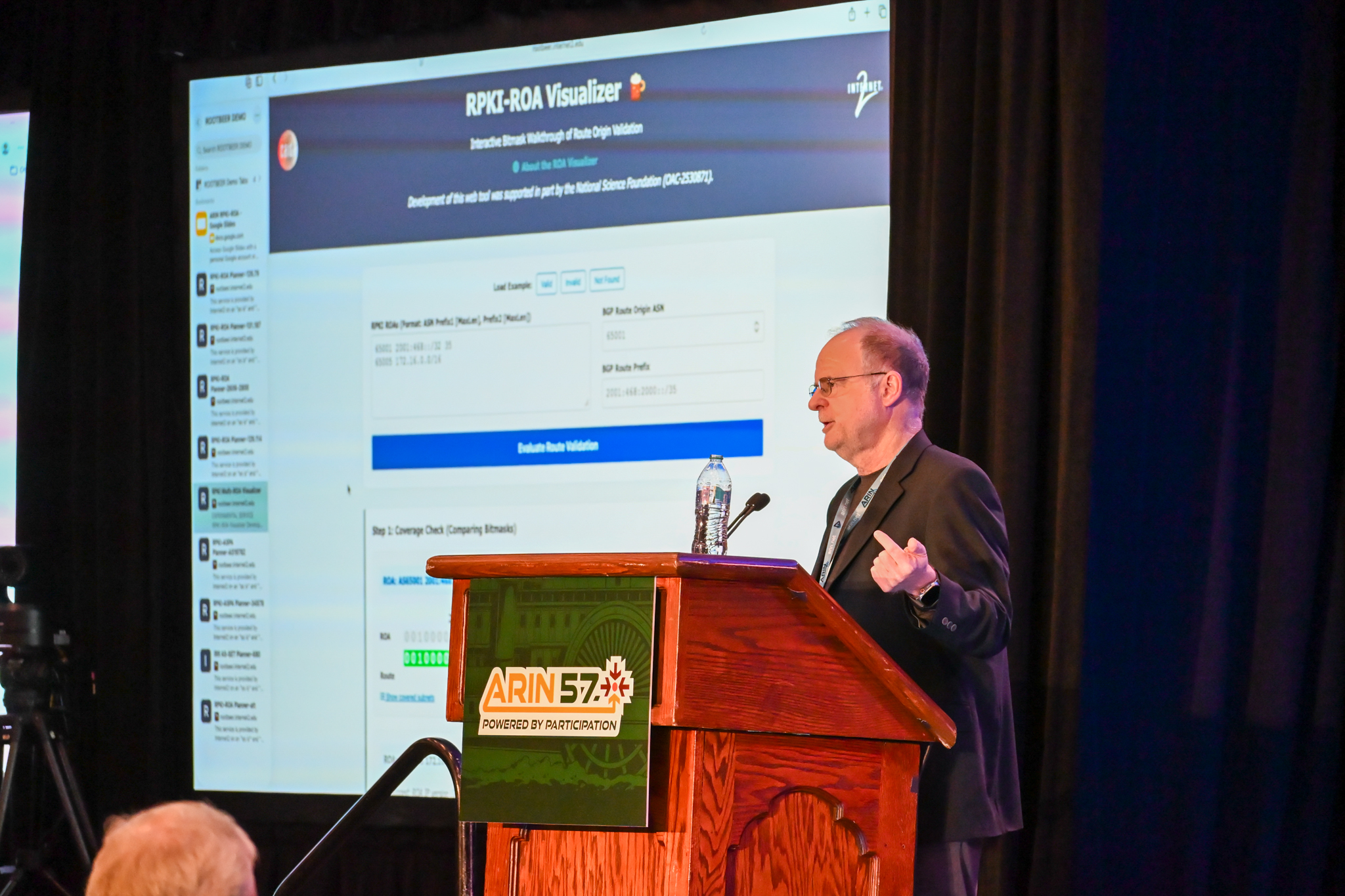
Steve also offered live demos of the tools, which are available at rootbeer.internet2.edu.
Steve’s presentation drew a strong response from meeting participants, with questions and comments ranging across the use of route validation tools to the difference in ASPA adoption rates between the research and education communities in Europe and North America.
Stay tuned to the blog for an in-depth look at this presentation in the coming weeks!
Policy Context
The meeting’s policy and governance reports then got underway. Eddie Diego, ARIN Policy Analyst, presented the Regional Policy Update, offering a glimpse at recent policy proposals from ARIN’s fellow Regional Internet Registries: AFRINIC, APNIC, LACNIC, and RIPE NCC.
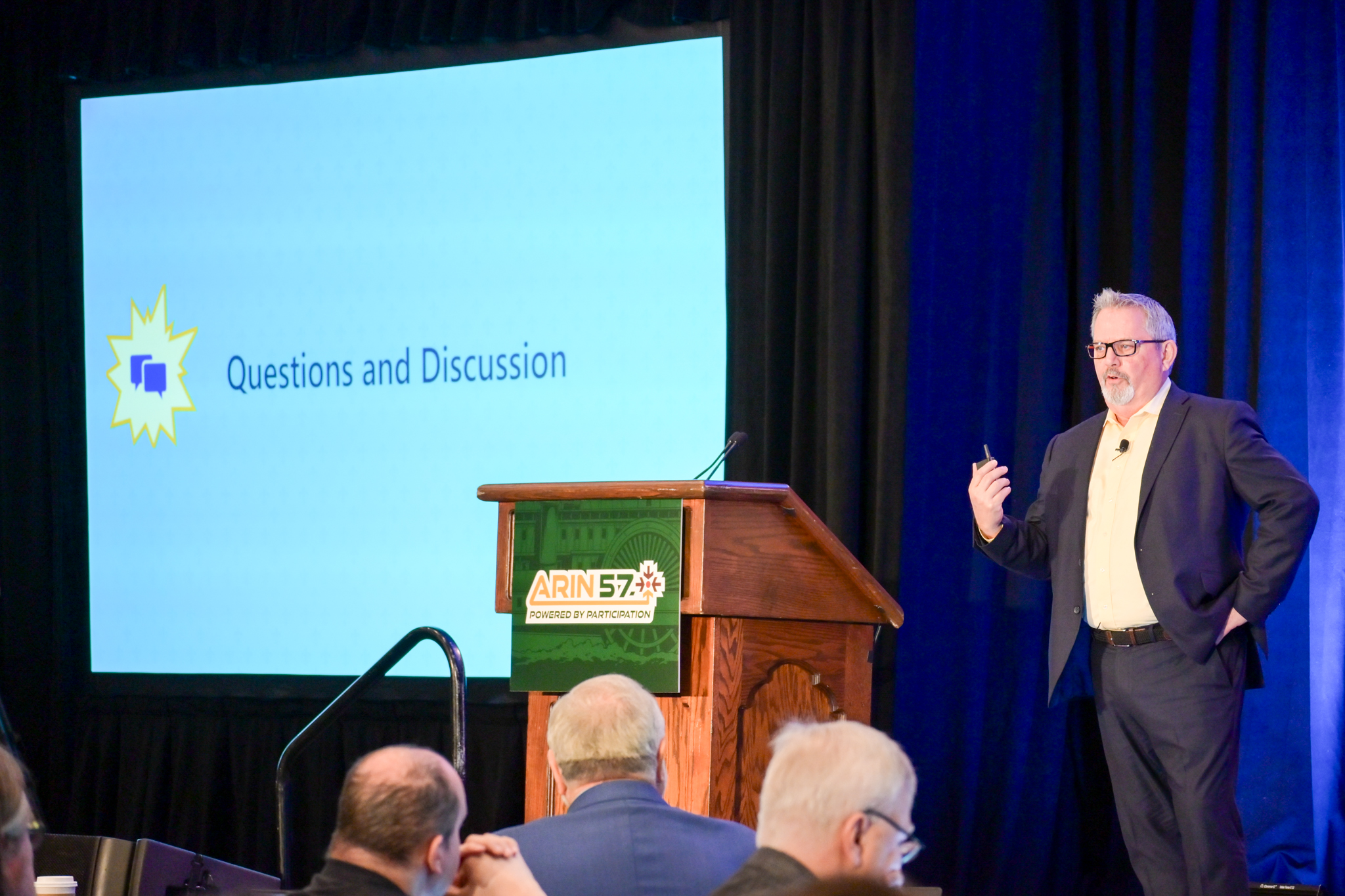
After a short break, Chief Experience Officer John Sweeting delivered the Policy Implementation and Experience Report, which focused on three policy areas: NRPM 8.4 Inter-RIR Transfers to Specified Recipients (with attention to AFRINIC’s newly ratified transfer policy); LACNIC’s sub-assignment of IPv4 resources to third parties; and approaches to encouraging IPv6 adoption via adjustments to IPv4 Waiting List policy. A notable update: ARIN intends to allow the transfer of IPv4 addresses and ASNs to and from AFRINIC once AFRINIC staff have completed implementation of their inter-RIR transfer policies — a significant step forward for the global registry system.
Join the discussion at the meeting or on our Public Policy Mailing List (PPML) to share your thoughts.
Next up, AC Chair Kathleen Hunter shared the Advisory Council Update and On-Docket Report, introducing how the AC operates and summarizing policy activity since the last meeting — including proposals received, items on the docket at ARIN 57, and statistics on proposal adoption and abandonment. She also provided an overview of the AC’s three working groups and encouraged in-person attendees to engage with those working groups by participating in Table Topics during lunch on day two of the meeting.
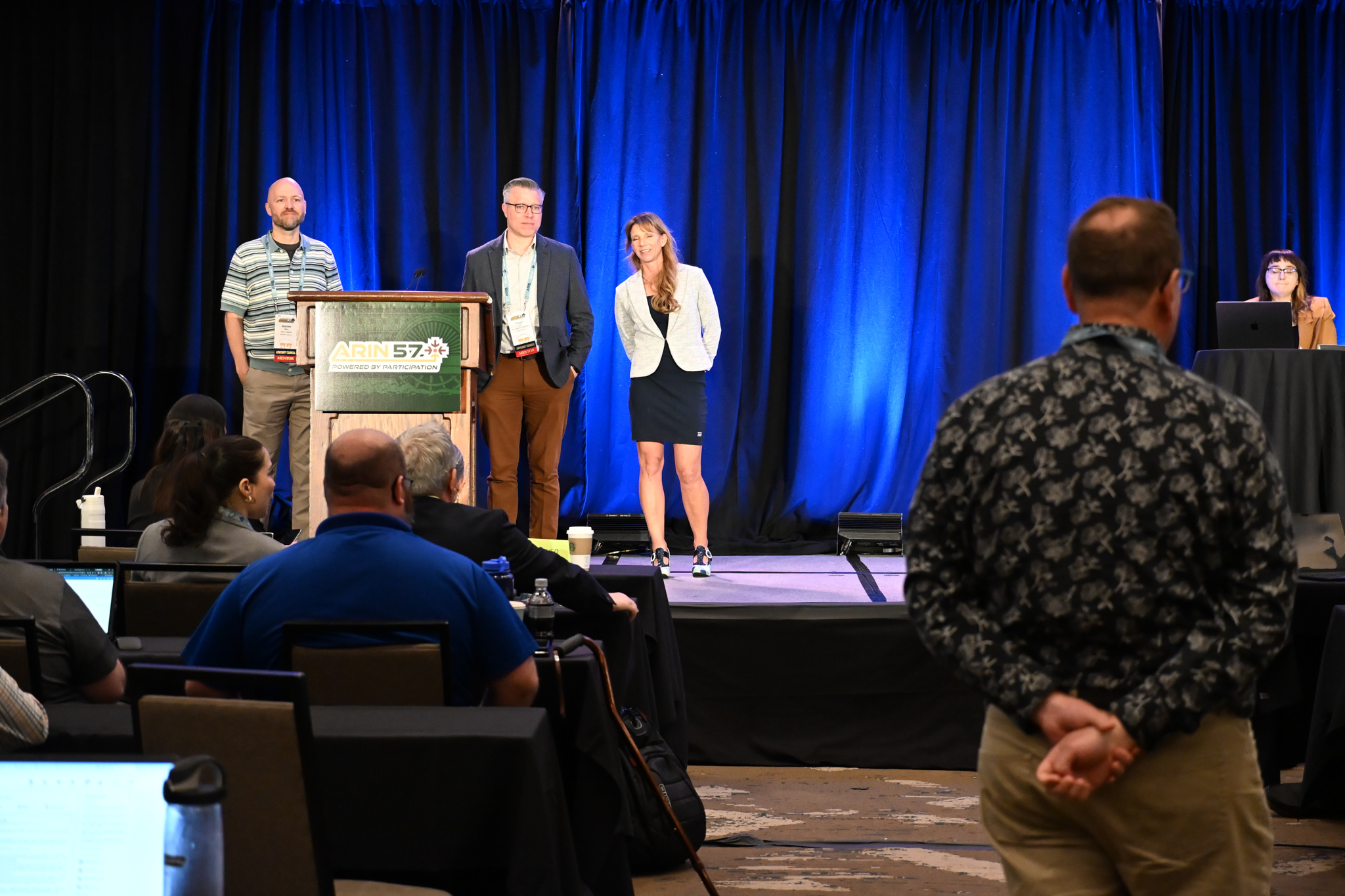
Doug Camin, Alison Wood, and Matthew Wilder followed with the Advisory Council Working Group Updates.
Doug, the AC Vice Chair, introduced the Advisory Council Working Groups. He said this new segment was the direct result of feedback from the Working Group chairs about how to create more time for community engagement and feedback as well as keeping everyone updated on the hard work these AC teams are doing.
Alison Wood, Chair of the Policy Experience Report (PER) Working Group, highlighted four active topics the group is examining:
- The potential elimination of NRPM 8.5.7 (Alternative Additional IPv4 Transfer Criteria), which may overlap with other transfer provisions and add unnecessary complexity
- Simplification of the IPv6 initial allocation language in NRPM 6.5.2.1
- Inter-RIR transfer discrepancies under NRPM 8.4, where differing needs-based requirements across RIRs may create asymmetry in transfer flows
- The consolidation of multiple overlapping IPv4 direct allocation policies (NRPM 4.1.8, 4.4, and 4.10)
Matthew Wilder, Chair of the Policy Engagement Working Group, shared results from the group’s first community survey on how to improve the policy engagement experience — with online surveys, self-service training videos, and a monthly policy digest among the most popular ideas — and noted that future surveys will explore the capabilities needed for new engagement tools.
Keynote Address: Leading Cats to Water in the IPv6 Era
After a lunch break to refuel and recharge for the afternoon, Inder Monga and Nick Buraglio of ESnet presented the second keynote of ARIN 57: “The Nine Lives of an Early Adopter: Leading Cats to Water in the IPv6 Era.”
The talk drew on ESnet’s nearly three-decade relationship with IPv6 — from its role as a founding partner in the 6Bone testbed in 1996, through receiving the first production IPv6 allocation from ARIN in 1999, to completing its ESnet6 build-out with an IPv6-only management plane in 2022.
Inder and Nick argued that the coming wave of AI agents is going to break IPv4. Using synthesized forecasts, they illustrated that active AI agents are expected to outnumber humans on the network by 2026, reaching 10 billion agents and potentially scaling to 900 billion by 2035. Running that volume of autonomous, parallel-tasking agents on NAT and private IPv4 addressing isn’t feasible; IPv6, they suggest, is a prerequisite for the AI-driven Internet to function at scale — requiring the simplicity, end-to-end consistency, and hyper-connectivity that IPv4 simply can’t deliver. ESnet’s own seven-generation infrastructure journey served to illustrate both how far adoption has come and how much organizational resistance has persisted along the way.
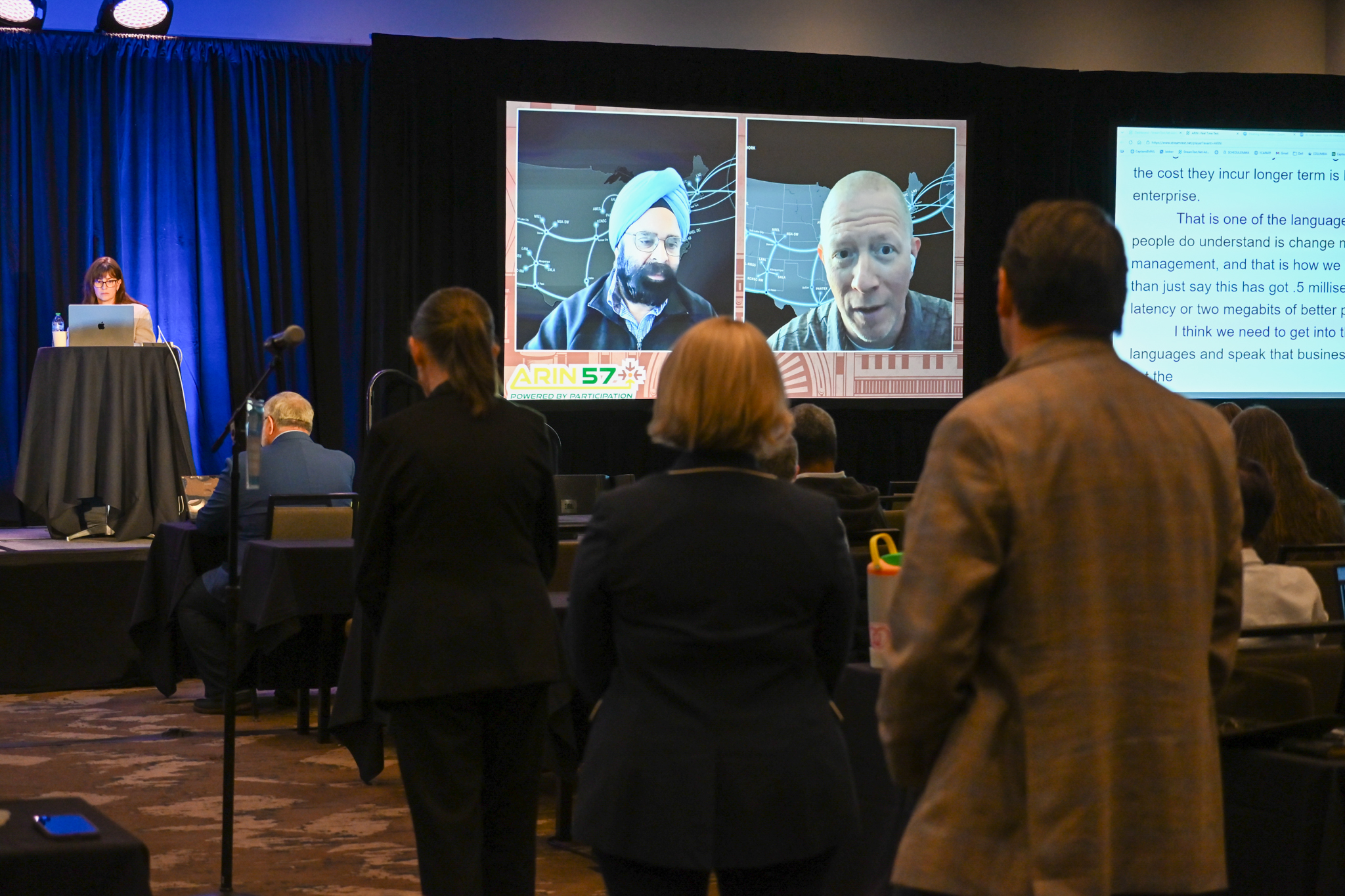
The keynote prompted lively discussion from the audience, with questions and comments touching on IPv6 adoption among U.S. government agencies, moving on from “evangelizing” IPv6 to treating it as the baseline norm, and the business case for IPv6.
Stay tuned for a deeper dive into this keynote on the ARIN blog in the coming weeks!
NRO and ICP-2 Updates
John Curran returned to the stage to deliver the Number Resource Organization (NRO) Report. He covered the NRO’s mission, structure, and 2026 finances, provided an update on AFRINIC, and reviewed the NRO RPKI Program’s 2026 objectives, including implementation of Trust Anchor Constraints and deployment of ASPA functionality across the RIR system. John also gave a status update on the ongoing ICP-2 Review process, noting that the Address Supporting Organization Address Council (ASO AC) plans to finalize the RIR Governance Document by Q4 2026.
ASO AC Vice Chair Amy Potter followed up with the NRO Number Council and RIR Governance Document Status Update, sharing a more in-depth explanation of the ASO AC’s role and the ICP-2 Review process to update the nearly 25-year-old Internet Coordination Policy 2 document with a new RIR Governance Document. She walked through the review timeline — from the publication of 24 core principles in October 2024 through two rounds of public consultation — and highlighted key topics currently in drafting for Version 3, including:
- The recognition unanimity requirement (where agreement has been reached to lower the threshold and account for conflicts of interest),
- Ad hoc audit procedures (now being renamed to ’targeted compliance reviews’ with agreed-upon processes), and
- Emergency continuity provisions (where the affected RIR will be able to initiate its own emergency continuity, and the threshold for initiation by ICANN and other RIRs is being lowered).
The next steps in the ICP-2 Review timeline, once the in-person working group finishes drafting the final version of the Document, are delivery to the NRO EC, presentation in RIR meeting and ICANN 87, and embarking on the NRO and ICANN approval and adoption processes.
ARIN 2025 Annual Report
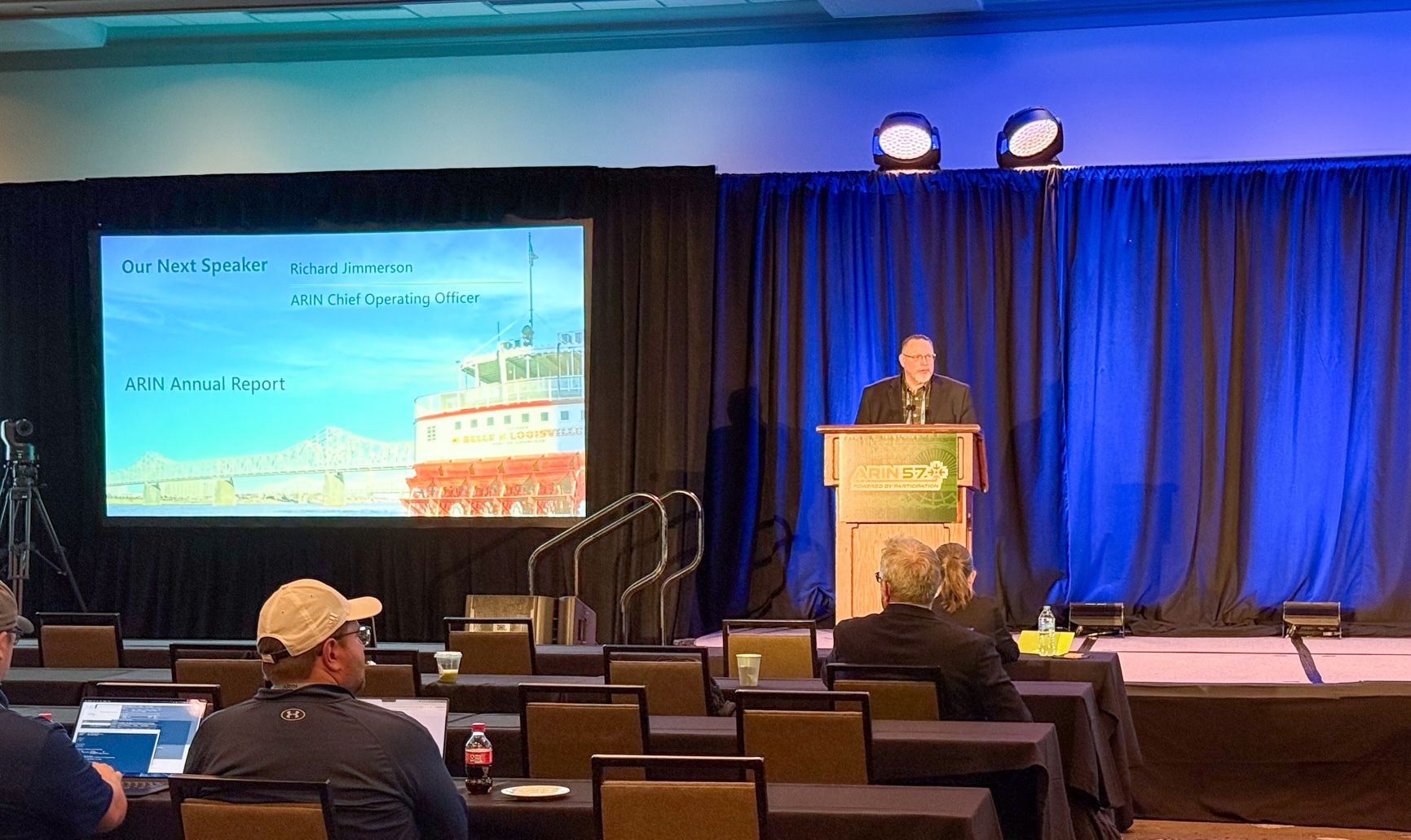
Richard Jimmerson, Chief Operating Officer, presented the ARIN Annual Report, wrapping up 2025 for the ARIN community.
Highlights from 2025 included:
- Membership: 25,085 Service Members and 1,472 General Members
- Registration activity: 1,922 IPv4 requests, 1,339 IPv6 requests, and 1,555 ASN requests, along with 540 transfers due to mergers, acquisitions, and reorganizations; 1,795 transfers to specified recipients within the ARIN region; and 445 inter-RIR transfers
- Technical milestones: Completion of the multiyear data center move; the transition to TLS 1.2 and 1.3; retirement of the FTP protocol; and new routing security capabilities including the IRR Auto-Manager, ROA Change Log, and integration of ASPAs into the OT&E environment
- Community outreach: 24 outreach events, 16 ARIN-hosted events, and 17 governance and international events attended; launch of ARIN Academy, a new e-learning platform offering; and US$50,000 in Community Grant Program awards across three projects
- Service levels: 99.9% or higher across all major service categories — Billing, Communications, Registry, Reporting, MFA, and Provisioning services
In Closing
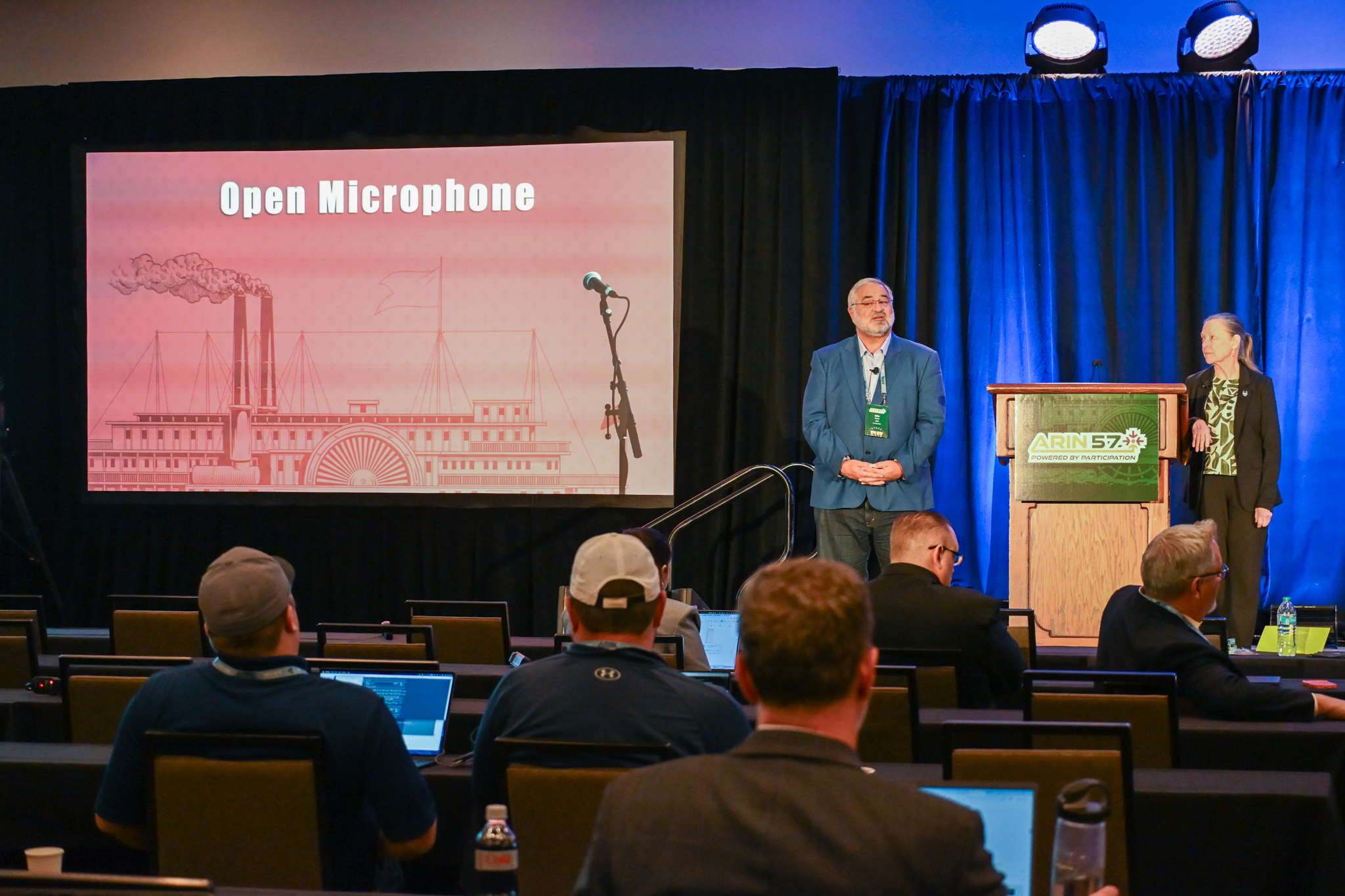
Last but not least, we took time for community members to ask questions or make comments during an open microphone session hosted by John Curran and Nancy Carter. Topics ranged from appreciation for the meeting’s technical presentations to future ARIN Academy courses to RPKI/ASPA.
Wrapping up the day, Hollis Kara closed with final announcements and adjournment.
See You Tomorrow
With that, we concluded day one of ARIN 57. Now we’re off to the ARIN Social tonight where we will network with our fellow meeting attendees.
If you would like to refer to anything you have seen (or missed) so far, all slides from today have been posted online on our ARIN 57 Meeting Materials page, and, over the next few days, we’ll also add links to the full transcript and webcasts.
Please use the #ARIN57 hashtag and tag us @arin_rir (Instagram), @TeamARIN (Facebook, X), or @ARIN (LinkedIn) when sharing your meeting experience on social media, and we’ll see you back here tomorrow for day two!
Taking photos or screenshots of your ARIN 57 experience? We’d love to share them! Tag, reply, comment, or message us on social media, or email us at social@arin.net with images (and photo credit, if needed) that you grant us permission to publish online.
Recent blogs categorized under: Public Policy
GET THE LATEST!
Sign up to receive the latest news about ARIN and the most pressing issues facing the Internet community.
SIGN ME UP →Blog Categories
Public Policy • Tips • Training • Security • Elections • ARIN Bits • Grant Program • Fellowship Program • Caribbean • IPv6 • Data Accuracy • IPv4 • Guest Post • Customer Feedback • Outreach • Internet Governance • RPKI • Updates • IRR • Business Case for IPv6