


The Nine Lives of an Early Adopter: ESnet’s IPv6 Journey — and Why It Matters Now
The ARIN 57 Public Policy and Members Meeting, held 19-22 April 2026 in Louisville, Kentucky, and online, featured a keynote address that brought three decades of real-world IPv6 experience to bear on the question the Internet community keeps asking: Are we there yet?
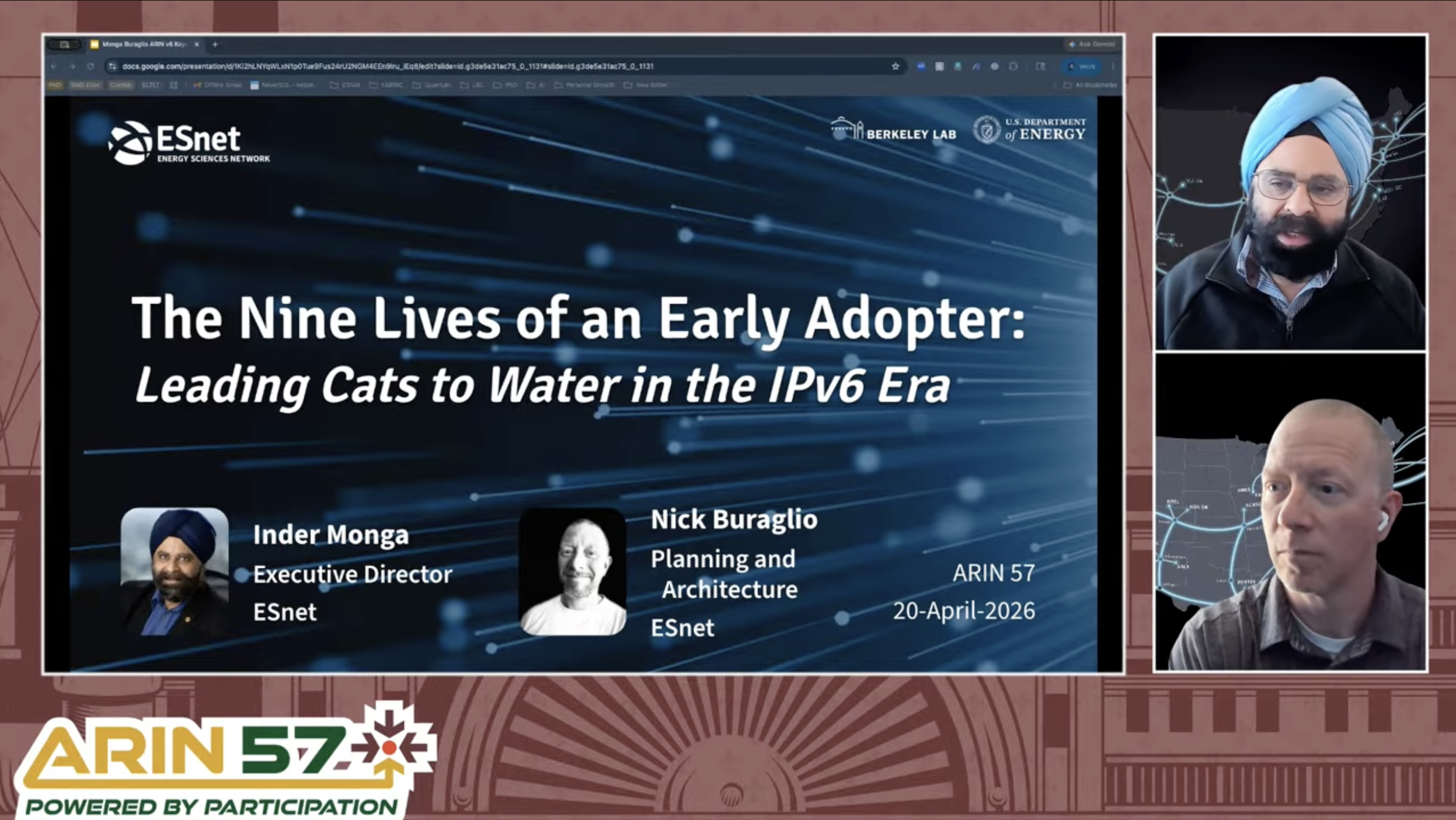
Inder Monga, Executive Director of ESnet, and Nick Buraglio, a member of the Planning and Architecture team at ESnet and co-chair of the IPv6 operations group within the IETF, joined the meeting virtually to deliver “The Nine Lives of an Early Adopter: Leading Cats to Water in the IPv6 Era.” Their presentation drew a compelling through line from ESnet’s earliest involvement with IPv6 in the mid-1990s to the practical realities — and opportunities — of IPv6-only deployments happening right now.
Watch Inder Monga and Nick Buraglio’s keynote address on YouTube and view the presentation slides in the ARIN 57 Meeting Report.
Two Protocols, Nine Lives
The title, the presenters explained, captures a fundamental truth about both protocols: IPv4 has survived far longer than anyone predicted, and IPv6 — despite decades of “imminent arrival” announcements that failed to materialize — has survived too.
Inder opened with a forward-looking provocation: the coming wave of AI agents. Drawing on Jensen Huang’s projection that there could be 100 AI agents operating for every human on the planet by 2035, he asked the audience to imagine what that kind of endpoint scale would look like if running on private IPv4 addressing and NAT. “Can you imagine running all these agents and giving them IPv4 private addressing and running NAT in order to have 900 billion agents talk to each other? Only IPv6 can handle the AI onslaught.”
His argument was structural: AI-driven hyperconnectivity demands simplicity (fewer middleboxes), consistency (a single addressing scheme that works end-to-end), and the ability to reach any endpoint from any other — properties that IPv6 delivers and that RFC 1918 space and NAT fundamentally cannot.
ESnet: 40 Years of Building Networks That Accelerate Science
To understand the presenters’ perspective, it helps to understand ESnet. The Department of Energy’s (DOE’s) primary research network, ESnet connects 17 national laboratories and 28 user facilities and science instruments worldwide. It spans 15,000 miles of leased dark fiber in the continental U.S., operates 79 points of presence, peers with approximately 270 active networks globally, and moves roughly 2.6 exabytes of data per year — with 14 sites connected at 400 gigabits per second or higher. This is a network that has been running IPv6 in production since 2004 and has been engaged with the protocol since it was still a draft RFC.
Inder walked through ESnet’s IPv6 touchpoints across three decades: collaborating with Sun, Digital, KAME, and Cisco on early IPv6 code development in 1995; providing overall management and coordination for the 6bone testbed starting in 1996; receiving ARIN’s first production IPv6 address allocation in 1999 (hershey.es.net, 2001:400:0:11:200:f8ff:fe75:6b57); co-sponsoring the 6TAP project with CANARIE that same year; and establishing the 6REN initiative to promote IPv6 adoption across research and education networks worldwide. Full IPv6 production support has been continuous since 2004.
Dual Stack: A Transitional State, Not a Destination
Nick took the next section of the talk, walking through where the community stands today — starting with an honest assessment of dual stack. When RFC 3484 was published in 2003, it defined IPv6 as the preferred protocol when both are available. That was a meaningful step, and dual stack has served as the de facto deployment model for roughly two decades. But it was always intended to be transitional, and its side effects are becoming harder to ignore.
“Dual stack may obfuscate significant issues. It fails to IPv4 when IPv6 is broken. That makes troubleshooting more complex — or, worse, it hides the need for troubleshooting altogether.” - Nick Buraglio
Happy Eyeballs, which allows applications to select the better-performing protocol at runtime, adds another layer of complexity on top of that. Running two protocols in parallel indefinitely is not, Nick argued, a sound long-term strategy.
The data from ESnet’s own traffic backs this up dramatically. High-energy physics research — including data moving from facilities like the Large Hadron Collider at CERN to the U.S. national laboratory complex — generates traffic volumes where IPv6 accounts for between 80 and 90 percent of the total. In one measured window, that translated to 4.3 petabytes of IPv6 traffic alongside 529 terabytes of IPv4. The high-energy physics community has been actively removing IPv4 from their networks, and their experience shows it can be done at significant scale without sacrificing performance.
Building IPv6-Only From the Ground Up
The most operationally compelling portion of the talk covered ESnet’s own IPv6-only deployments. Before the Office of Management and Budget (OMB) published its 2020 mandate to complete the U.S. government’s transition to IPv6, ESnet had already built an IPv6-only management network as part of its current generation infrastructure — covering everything from optical equipment and management protocols to the ancillary hardware in every point of presence. Years of vendor engagement went into making it work.
When the OMB mandate arrived, ESnet was already prepared. More than that, the IPv6-only management network had given ESnet’s team deep institutional knowledge of how to interact with vendors and how to communicate requirements to constituents — knowledge that would prove essential in the next phase.
The DOE’s IPv6-only pilot was not the management network, but ESnet’s own office building: two floors of daily-use workspace, running IPv6-only for nearly six years now, with no dual-stacked hosts. Every device on the network operates with only an IPv6 address. NAT64 and DNS64 handle translation for IPv4-only content, and the absence of a client-side address translator during the early phase of the pilot surfaced the software, hardware, and documentation gaps that the team needed to find.
“Removing IPv4 reveals gaps. Software support, hardware support, documentation, tool capabilities — all of these things started showing up, and that allowed us to say: ‘Now we need to talk to this vendor. Now we need to update this firmware.’ That is an advantage.” - Nick Buraglio
That work also produced tangible contributions to the standards community. Gaps found in source address selection led to a draft update to RFC 6724 — now waiting for publication — that emerged directly from ESnet’s operational experience.
IPv6-Only Data Centers: The Operational Case
ESnet has also applied these lessons to a new data center built as IPv6-only from the start. Nick described the advantages as the team experienced them: lower operational overhead from running a single protocol; simplified address provisioning that lends itself well to zero-trust architectures; freedom from RFC 1918 address space and its scaling limitations; and a significant reduction in policy complexity. “One set of policies. No compromises for address space," he said. “And little to no translation overhead when everything is IPv6.”
Where Things Stand — and What Comes Next
By the numbers, IPv6 is no longer a fringe protocol. Approximately 50 percent of global Internet traffic is now IPv6. In the United States, the share is slightly above 52 percent. France sits at around 80 percent. Mobile traffic is 50 percent more likely to be IPv6. More than 50 countries have mandates or active encouragement for IPv6 or IPv6-only deployment between now and 2030.
Enterprises, the presenters noted, remain the last significant frontier.
Inder closed with a call to action that folded in the AI argument from the opening: AI agents are coming, and they will need addressing that works at scale, without friction, and without the layers of complexity imposed by IPv4 and NAT.
“Dual stack is a Schrödinger trap, not a destination. It doubles your complexity and hides broken connectivity.” - Inder Monga
Complacency, he argued, is the biggest bottleneck — because software and vendor gaps only get fixed when operators force the transition by depending on IPv6 and making clear that IPv4-only support is unacceptable.
His closing challenge was direct: Start an IPv6-only pilot this year. Stop herding IPv4 cats — and start turning IPv4 off.
A Lively Q&A
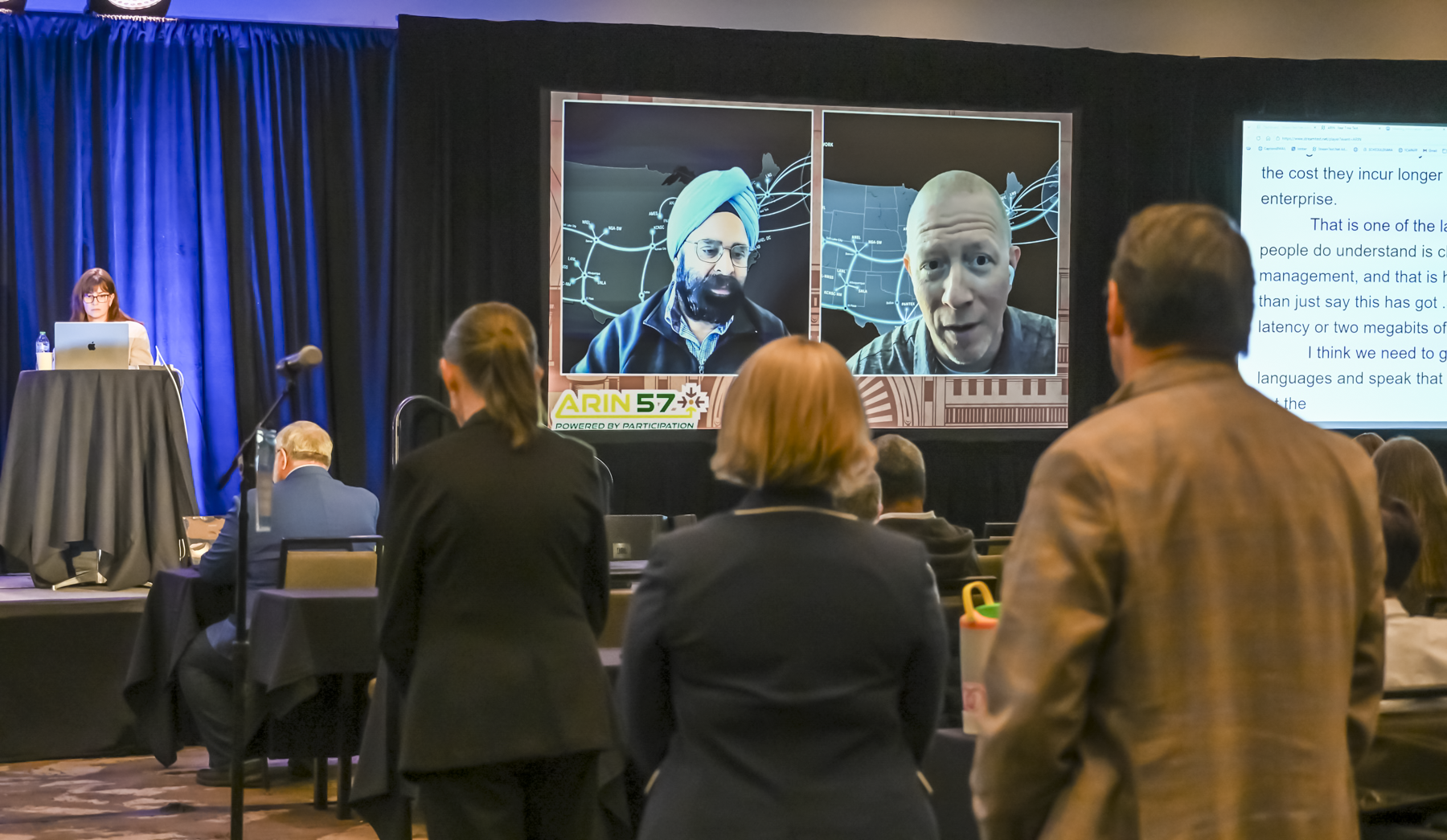
The Q&A following the presentation drew engagement from throughout the room and online. E. Marie Brierley of the ARIN Advisory Council offered one of the session’s most practical contributions: a reminder that IPv6 capability is now a hard requirement on U.S. government contracts submitted through SAM.gov — and that bids from vendors who cannot demonstrate it are being rejected outright, with no exceptions.
“I don’t have to tell any of you how expensive that is,” she said. For organizations still weighing whether to prioritize IPv6, this framing makes it crystal clear that this is no longer only a technical question, but also a business risk one.
Michael Ackerman of Blue Cross raised the challenge of selling IPv6 to nontechnical management and asked for the most compelling business cases. Inder pointed to simplicity — the elimination of middleboxes, the ability to connect seamlessly across locations and with cloud infrastructure that is increasingly IPv6-native.
Henrik Van Tassell, an ARIN 57 Fellow and self-described IPv6 enthusiast, posed a question that cut to the heart of the adoption challenge: What do you say to someone who argues that mass IPv6 adoption may never arrive before some other solution emerges — or who simply reasons that doing nothing costs nothing?
Nick’s answer was direct, and arguably the most quotable of the session: You probably can’t convince someone who doesn’t want to be convinced. “People have to want to do it,” he said. “If you try to force them, they’re going to recoil.” His preferred approach is to show rather than argue — and the most compelling exhibit is already in most people’s pockets. Many mobile subscribers have been carrying an IPv6-only device for nearly a decade or more without knowing it: “Something that critical that doesn’t even run IPv4, that you use to connect to the rest of the world all day every day — I think that proves in and of itself that this is an extremely well-traveled, very reliable, obviously usable protocol.”
Inder added a management lens to Nick’s observation: At a certain point, IPv6 adoption becomes a change management challenge, not a technical one. “People are afraid of change. That’s the bottom line.” The argument that resonates in boardrooms isn’t latency benchmarks — it’s risk. The cost of transitioning may feel high today, but the long-term risk and cost of not moving is higher. “That is one of the languages that business people do understand — change management and risk management,” Inder said. “And that is how we need to do it.”
Nancy Carter of the ARIN Board of Trustees closed with an encouragement to the ESnet team to continue leading by example, and Christopher Quesada of Verisign called for the presentation to be brought to NANOG and other Regional Internet Registry meetings — a sentiment that received visible support in the room.
The Invitation Is Open
The slides from Inder and Nick’s presentation, along with a full recording, are available in the ARIN 57 Meeting Report. Their message is practical, data-grounded, and timely: The inflection point has arrived. The question is no longer whether IPv6 works. It’s whether your organization is ready to lead — or waiting to be dragged.
Learn more about planning for, requesting, and deploying IPv6 at arin.net/IPv6.
Recent blogs categorized under: IPv6
GET THE LATEST!
Sign up to receive the latest news about ARIN and the most pressing issues facing the Internet community.
SIGN ME UP →Blog Categories
Tips • Training • Security • Public Policy • Elections • ARIN Bits • Grant Program • Fellowship Program • Caribbean • IPv6 • Data Accuracy • IPv4 • Guest Post • Customer Feedback • Outreach • Internet Governance • RPKI • Updates • IRR • Business Case for IPv6